    Blog Series: Lighting Education

    Inspiration is Everywhere!

    Inspiration is everywhere

    One of my favorite questions to ask lighting designers is “Where do you find inspiration?”. As a designer myself, I can answer this question both simply and complexly with a one word answer – everywhere.

    I can say this because I look at lighting as a natural occurrence rather than a technological creation. Light is everywhere. This seems like a no brainer, right, I mean, come on, of course light is everywhere. How else would we see? However, there is a more subtle reality at work here. Stick with me while I try to explain myself.

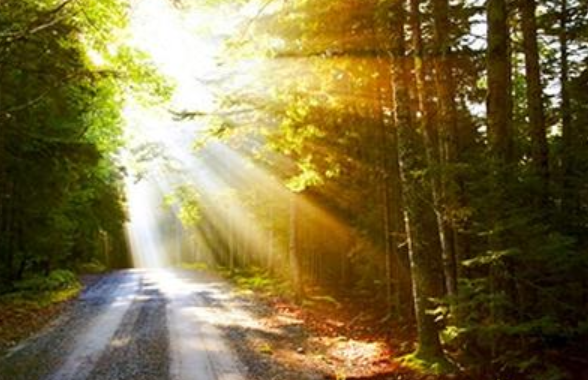
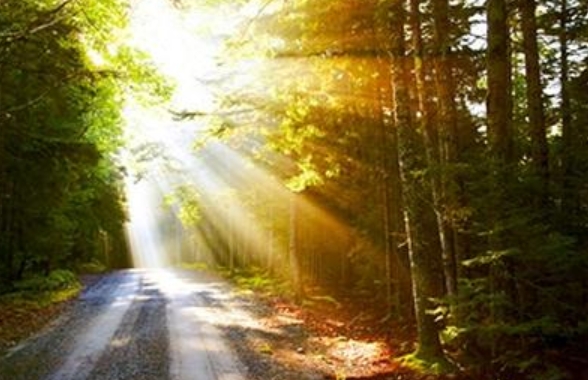
    Think about natural light and what it is comprised of. The sun produces a vast spectrum of energy, of which a small sliver of that is visible light. Of that sliver, our eyes manipulate it in such a way as to allow our brains to dissect it into a visual representation that we can see as either colors, or a variation of white light. I say a variation because as we know, there are several different flavors of white light in nature. Think about this as well, what is the obsession with natural light. Why is it that several blog posts and Lighting Insights deal directly with natural light rather than manufactured light? Basically, it is because I firmly believe that we as humans are designed to see natural light as the energy that it is. Our brains crave it. We crave full spectrum light! Science has proved that sunlight produces vitamin D, which is an essential part of our vitamin consumption. Beyond that, natural light is the best inspiration to look to for us as lighting designers. Nature provides us with the most amazing canvas of colors on a daily basis. When you are done reading this, get up from your computer and go outside and look at the building that you just came out of. Look at how shadows fall across the windows or under the trees. Look at the way that the light is refracted off of a lake or even a puddle in the parking lot. All of this is simple ways of seeing inspiration for design.

    natural light


    Now, let’s take another step. This one is pretty cool. Go into a room in your home that gets the best sunlight. Turn on all of the lights and close the shades. If you are like me, you are in the process or have changed out to LED light bulbs (that’s right, I said light bulbs, not lamps, deal with it). Take a look at the paint colors on the walls. They are going to look a certain way based on the color temperature and makeup of your indoor light source. If you are using incandescent, your spectrum is pretty wide, if you are using CFLs (Compact Fluorescent Lights), the spectrum is pretty narrow, and if you are using LEDs, then again, the spectrum is pretty narrow, but will still look better than the CFLs. Take a good look at the walls, the furniture, the floor coverings and whatever else is in the room. Remember the colors. Now shut off the light sources in the room and open the shades. You will notice that the colors in the room look completely different now. If it is a cloudy day, they might look less vibrant, if it is a sunny day, more vibrant. Why is this important? Because natural light is reality, and reality never lies. Our lighting design should be based on natural light where ever possible. It is our job to try to re-create these kinds of colors so that our shows mimic what our eyes crave.

    natural room


    So, last night I was at Church. My son sings in the choir, so I sit as close as I can to where he sings. Mass started at 5:00 PM and my seat faces the south stained glass windows. And I am of to the side and slightly behind the alter. Our church is set up in the round with the alter centered. About 15 minutes into the mass the sun shone through that glass like the ultimate single source directional light that it is. It illuminated that glass and every single color in it. There are reds, greens, blues, yellows, and every shade in between in the glass, and they all projected at once on the alter and choir. But it was not just the light that was produced; it was the shadows as well. Looking at the vestments of the priests and how the light and dark worked together to create dimension looked like something that you would see in a renaissance painting. The fact that it overpowered the house light and created so much dimension and drama was amazing. Not because it was Church and it was some kind of sign, but because it was inspiring to me and a look that I would love to attempt to reproduce. What was even better, was the fact that the clouds would occasionally diffuse the sun and mute the window to allow the houselights to take over again, which added to the effect. It was really something to see. I was tempted to take photos, but I knew that they would not do justice to how my eyes saw it. Anyway, it was very cool. This is one of the reasons that I find the natural light inside churches to be one of my favorite inspirations in lighting.

    church light

    What are the takeaways’ from this? Well, you could say that I have an un-natural obsession with natural light, or you could get up and see how natural light could influence your design style for yourself. Either way, I hope that you do get up and go look around and see what inspires you and think about it the next time you are making layers of light. Using multiple colors to light a stage, or people is totally natural. Using different levels of light in your front, side, and back lights is perfectly acceptable since natural light is anything but flat

    Let this thought rattle around inside your brain for a bit….Is natural light the composition of the visible spectrum, or does the visible spectrum come together for us to create the white light that our brain sees?

    Mentoring the Future of Our Industry

    The future of the lighting industry is in our hands. That seems like a big responsibility, and it is, but together, we can make sure that the next generation of lighting professionals is ready to face the challenges of entertainment lighting as we move evermore forward into the digital age of lighting.

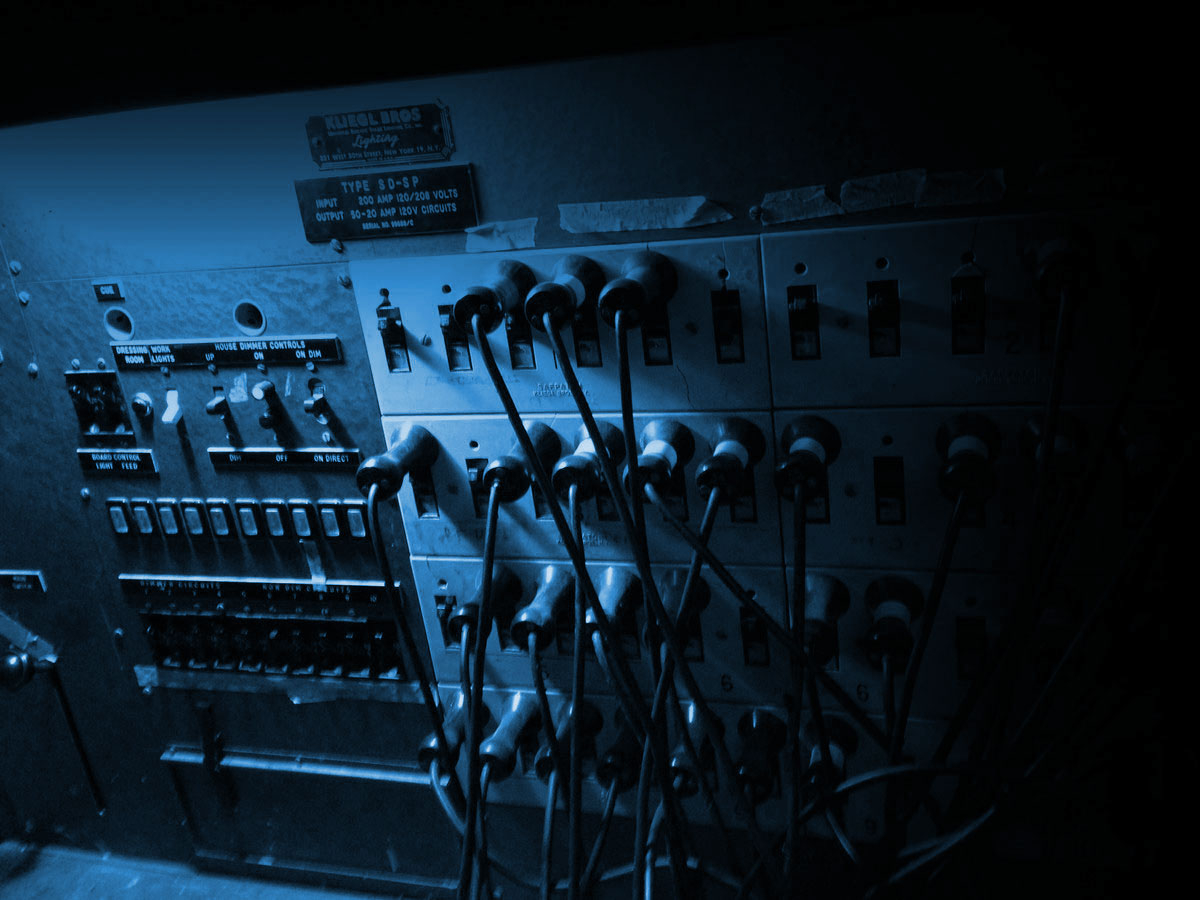
    For those of us in the 40+ portion of the industry, we all remember the world before DMX. A lot more cable, clunky control systems, and dimmer racks that went on for miles. With the advent of LED and the Windows based lighting controllers, that all changed. Now, when I hear someone say that they can focus a par can rig in no time flat, I have to think to myself, “Yea, that’s great, but when is the last time you saw an all par can rig?” The truth is that the skill of being able to focus a par can rig is now almost part of our history. That is like saying “I know how to use a telephone style patch board”. Many lighting professionals today have never seen one of those old 2 scene preset consoles that we used to use that had those old systems. Again, it’s all history. BUT HISTORY IS IMPORTANT!!! and by mentoring the people coming up in the industry, we can make a positive impact on the future, so when we retire, we know we have left it in good hands.


    dimmer control

    I am not suggesting that we should force people coming up in the business to learn how to use a Kliegl Brothers 2 Scene Preset lighting system. The amount of asbestos in those old systems alone would be deemed an environmental hazard. I am suggesting that it is important to talk about them because the idea of how they ran is still relevant.

    Let’s take patching for example. Now patching is almost always done one to one. This is to say, that there is one channel per circuit, or one channel of a fixture personality to one channel of DMX. It’s all done virtually on the console now. It used to be done physically on the side of the stage. Someone physically assigned pin (output circuit) 23 to dimmer (channel) 6. If this was the only channel assigned to dimmer 6, that was dimmer per circuit. However, most people used multiple circuits on a single dimmer so that they could maximize the amount of lights that would be controlled by a single dimmer. This meant that no matter what, when I raise up channel 6 on the console, dimmer 6 would bring up whatever lights were plugged into it. Why is knowing this important? It is important because if you can visualize the physical track that your channels take when you set up a system, it can help in system design and trouble shooting. Learning how patching works from someone who has physically patched fixtures will show you the value of understanding how your system layout actually works.

    dimmer patch bay


    Now, back to the par can guy. Why is it important to be able to focus par cans quickly? The same reason it is important to focus anything quickly. Time is money. Learning how to focus lights from someone who has done it for a long time can be a big advantage. They know the tricks on how to find your best light, even during a daytime outdoor focus call quickly and effectively. Trust me, that is a great skill to have.

    Def_Leppard_Sweden_Rock_2008

    So, OLD GUYS, the next time someone asks you for your help or advice, don’t just throw them the line “I learned it the hard way, welcome to the game!” take a moment and actually help the person out. And by the same token, YOUNG GUYS, listen to what the experienced guys are telling you. They have a ton of life experiences that you don’t. Let the lessons they learned the hard way make your life a little easier. Trust me, you will have to learn enough things the hard way yourself.  This is a collaborative business and there is room for everyone!

    NAMM 2016, and CHAUVET Professional is Bringing the Harmony of Light

    The stage is set for another exciting NAMM show in Anaheim California!  CHAUVET Professional is very exited to partner up with CHAUVET DJ to bring you another fantastic trade show experience.  This year, we plan on making all of our noise with the colors of light.  All of the products that we are going to be showing at this show are ready to impress.  Before you come to the show tomorrow, here are some of our fixtures that we know will knock your socks off.

    The Epix Tour Series consists of three products.  The Epix Stip Tour, Epix Bar Tour, and Epix Drive 900.  Épix Strip Tour is a pixel-mapping 1-meter LED strip, featuring 50 LEDs in a row and a 125-degree viewing angle..For added versatility and more creative options, a dome accessory is available to widen the viewing angle to up to 180 degrees.  Epix Bar Tour is a pixel-mapping 1-meter LED bar, featuring 150 LEDs in three rows and a 125 degrees viewing angle.  Épix Drive 900 hosts the processing and power supply for the Épix Tour system. It supports either18 Épix Strip Tours or 6 Épix Bar Tours, or any combination of the two, with a total capacity of 900 LEDs. Épix Drive 900 supports Art-Net, Kling-Net, and sACN, giving you a variety of control options.  Thanks to an integrated web server, you can remotely diagnose, troubleshoot, and change settings as needed without having to directly access the Épix lights.

    The COLORado 1 Solo builds on the pedigree of our COLORado line of fixtures with new all-environment performance and advanced optics. This powerful RGBW LED wash projects an even, fully homogenized beam through fast and smooth zooming optics. Utilizing new IP rated power and data connectors and full convection cooling allows this fixture to perform anywhere from a silent main stage theater to an outdoor summer music festival.

    The COLORdash S-Par 1 is the first of the next generation of COLORdash family of products which appear to have a single light source. Using a new high-power RGBA LED engine and homogenizing optic, COLORdash S-Par 1 is poised to become the workhorse of the Event lighting industry. The RGBA LEDs produce a beautifully blended color palette with a subtle soft edge. Fully convection cooled and using IP rated power and data connectors allows the fixture to be used indoors or out. An innovative touch display and rugged split yoke make this fixture perfect for any event.

    Ovation E-910FC is fully featured color mixing ERS-style fixture. It features full RGBA-Lime color mixing with output rivaling an incandescent fixture. Sacrifice nothing when it comes to control options with modes providing full 16-bit dimming (per color and master), selectable PWM, RDM and on-board dimming curve selection. Also accessible is our Virtual Color Wheel which matches popular gel colors when projected by a tungsten source, in addition we have added color temperature presets from 2800 to 6500 K that match a tungsten source to perfection.

     STRIKE 4 is CHAUVET Professional’s answer to your multi-format LED warm-white wash needs! STRIKE 4 features four independently focusable 100W chip-on-board LEDs that provide incredible output and coverage for a wide gamut of production genres. STRIKE 4 features smooth 16-bit dimming control for those incandescent-style fades, a series of automated strobe effects for using the STRIKE 4 as an audience blinder, individual manual pan control of each LED pod and adjustable PWM for using the STRIKE 4 in film and studio locations. STRIKE 4 comes standard with basic and advanced control personalities for flexibility in programming, and an easy-to-read OLED display for quick onboard adjustments.

    Ovation Min-E-10CW complements Ovation Min-E-10WW in a cool white LED version with zooming optics. This ultra-discreet ellipsoidal is perfect for punchy gobo projections in a multitude of applications. It features a four-blade shutter system to efficiently and cleanly crop light from unwanted areas with nice crisp edges. The 19° to 36° zooming optic provides the flexibility to precisely adjust your projection size. Ovation Min-E-10CW is easily dimmed using traditional dimmer packs.

    WELL Fit is a must for event lighting. A discrete, high powered LED up-lighter, this small battery powered wash light comes in a reflective chrome housing designed to blend into any décor. WELL Fit can be controlled wirelessly either by W-DMX or by an included IR remote; alternatively, it can be controlled manually from the OLED display on the fixture. All of these features combined make the WELL Fit a perfect solution for quick setup and distinguished accent lighting.

    Rogue R1 Wash distinguishes itself by offering a combination of performance features unique to its price class. Powered by seven RGBW 15W quad-LEDs, this bright and versatile moving wash zoom fixture features a unique “bubble” lens design for excellent color rendering and stunning visual effects. Other standout features include an industry standard setting 11° to 48° beam angle, incredibly fast and smooth pan and tilt movements, simple and complex DMX channel profiles, plus 3-pin and 5-pin DMX connectors. Versatility, value and performance make this fixture a welcome addition to any touring rig or permanent installation.

    Rogue R2 Wash makes a valuable addition to rental and production inventories. Durable and dependable, this moving wash workhorse produces a bright, powerful light and offers five zones of LED control to pixel map its 19 (15 W) RGBW quad-LEDs. An industry leading zoom range of 12-49° gives the Rogue R2 Wash the spread to cover even the largest areas. Smooth color mixing, simple and complex DMX channel profiles and powerCON in and out are just some of the other features that make this fixture a standout performer in any setting.

    Rogue RH1 Hybrid pushes the performance boundaries for automated moving fixtures to new heights. This hybrid beam and spot possesses an unrivaled optical system with 8-facet and 6-facet prism sets that are completely layerable and controllable. Powered by a 330W Osram Sirius lamp, Rogue RH1 Hybrid delivers an ultra-intense output of 111,000 LUX @ 15m with tight beam angles of 1-4.5° in Beam Mode and a zoom range of 5-19° in Spot Mode. Indexing and static scrolling gobo wheels and a 13-hue color wheel add to the stunning visual effects that this amazing tool can create

    Rogue R1 Spot brings innovation and creativity with a rotating 3-facet prism for stunning aerial effects, a motorized iris and focus for beam shaping, as well as two gobo wheels, one of which rotates and has 7 interchangeable gobos for custom looks. Rogue R1 Spot shines brightly with a 16.5° beam angle for crisp gobo projections in a range of eight beautiful colors.

    With all of that and a few more at the show, this is bound to be an exciting one for everyone! Stop by and say hi, we can’t wait to see you!

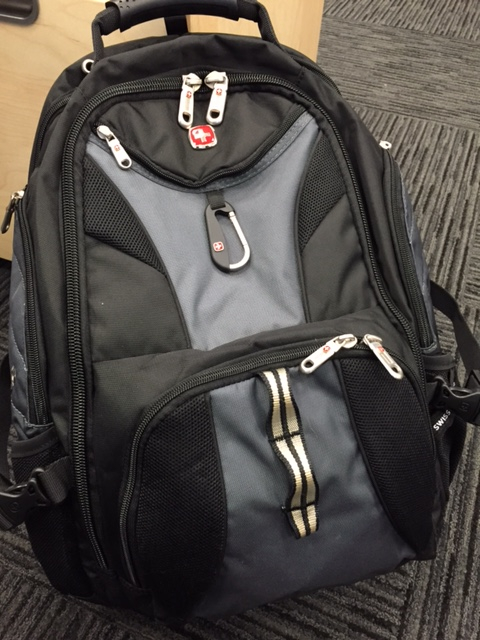
    Gig Bag – Or, Why is My Backpack So Heavy?

    Whenever I pick up my gig bag, I always think to myself, “I need to pack less stuff”. The truth is, over the years, I think I have done a pretty good job of making sure that I only take what I need.


    Depending on the gig, I make sure to pack well, but not over pack.  Having too much gear can be as much of a pain as not having enough gear.  Too much gear means that there are items you have to account for that you did not even use.


    Indoor gig –

    Essential Tools –      These are all tools that I know I can’t live without on a job site.  These are all things that everyone should have in their bag.

    Crescent wrench

    Razor knife

    #2 long handle Philips head screw driver

    Flathead screw driver

    Flashlight

    Side cutters

    Small multi meter

    Dental picks

    3 – 5 pin turn around DMX cables

    Allen Keys

    Tape Measure

    Sharpies

    Pen / pad

    DMX tester

    Show paperwork (plot, patch, gear list, ect.)

    Optional Tools –  These are tools you might want to take just so that you know you have them.

    Truss tools – I say optional because they should be provided by the gear supplier, but if you have your own, that is never a bad thing. Just make sure that they have your name engraved on them.

    Triple tap – When you get to the FOH, you might need to plug in more stuff than you have outlets for and this will save you having to go look for one.

    Essential electronics –    In order to do my job, I know I have to have some blinky lights and gadgets.  Here are the ones I can’t live without.

    laptop, I pad or Surface style computer – I like the Surface because it has a USB port built in and I can easily plug in any of my USB control platforms into it if I have to. It is also really lightweight and small.

    Thumbdrive with your show file on it – Sorry, but this is a must have. Always try to have your patch done before you get onsite. This will save you massive amounts of load in time.

    Charging plugs – Laptop, Phone, ect. You will need them.

    Phone – goes without saying, but throw it on your checklist anyway.

    Single universe lighting controller – many lighting control companies have single universe dongles that are relatively inexpensive and can run a universe of DMX, or more depending on the controller. This is a good way to have some backup to your show.

    Personal stuff –  This is all creature comfort stuff that I have in my bag to keep me comfortable during the day.  I know that at some point I am going to need all of this stuff.  Not having to go and find this stuff when you are on site will save you time and stress.

    Aleve – Not just for the headache you might get, but for the body ache you know you’re going to get

    Ear plugs – to help you avoid the headache you might get, also, because hearing is important and does not get better with age.

    Gold Bond – no explanation necessary

    Spare Socks – this is an absolute must for me. If I forget every other personal item, spare socks is one that I refuse to live without. Dry feet are essential. After load in, I change my socks. Foot comfort is one of those things that you forget about until your feet hurt.

    Spare t-shirt – If I have to work FOH during the show, I never wear the same shirt I had on during load in. I know it will smell and most likely be dirty. I am representing not only myself, but the person who hired me to do the job. I need to look presentable.

    Deodorant – see the above

    Cash – not all roach coaches take credit cards.

    That pretty much covers the indoor gig. With this gear in your backpack, you have a pretty solid gig bag to get you through your day as a lighting guy. We all have the things we can’t live without, and this is my list. When it comes to outdoor shows, the only things that change are some additions personal items that I bring with me:

    outdoor gig


    Toilet Paper – With the combination of the roach coach and the porta potty, having your own will save your….

    Wet wipes – see the above.

    Sunglasses – due to the fact that everyone in our industry is part vampire, they are essential.

    Sunscreen – see above

    Bug spray – did a gig over the weekend and wished I had some. I had to borrow from the sound guy. Borrowing from the sound guy is embarrassing.

    Full change of clothes – and even an additional extra pair of socks. The reason for all of this is because if it rains, you need a change of clothes. Sitting in wet clothes is the worst way to spend a day.

    Towel – you never know.

    Also, make sure that the company that you are working for is providing a tent for front of house. There are a few reasons for this. The biggest is that it will protect you from the sun or rain depending on the day. Also, it is impossible to see the screens on your lighting controller in direct sunlight. You need some kind of shade to make that possible.


    2015 Brought us Prism Power in a big way

    Congratulations to our CHAUVET Professional video team for hitting the top 10 most viewed videos on Live Design’s website.  Way to go team!.  The Rogue RH1 Prism Power video made waves in the industry and helped us launch a product that offered something different to the lighting world.  Check it out one more time!


    The Color of White

    A not so long time ago in the galaxy of which you live in, the entertainment lighting world was dominated by two types of light sources – halogen and arc-source lamps.
    These two types of sources were used for broad range of lighting fixtures and for the majority of the industry; our fixtures were defined by the light source that was in them.  Almost all moving head fixtures were lamped with arc-source lamps, and static wash lights were lamped with halogen lamps. There were some exceptions to this rule, especially in film and television, but for our discussion today, we are going to leave it as arc-source for movers, and halogen for statics. This further helped us define our lights for specification. For example, we knew that a 750W Ellipsoidal was perfect for onstage and front of house lighting situations for theatre and that a 250W moving head spot was the ideal nightclub fixture based on its 250W arc-source lamp. We also knew exactly what the quality of white light was going to come out of these fixtures.
    Halogen lamps are always warm in color temperature. For example, the most popular lamp in the 750W Ellipsoidal range is the HPL 750W lamp.

    HPL 750


    It comes from a variety of manufacturers, but the spec is pretty much the same. It has a CRI of 100 and a color temperature of 3250K. The HPL 575 lamp is also pretty common. The color temperature is a little warmer at 3050K, and the CRI is still 100. The typical range of Halogen lamps is between 2800K and 3200K.

    Arc Source lamps are always cooler in color. Usually ranging from 5600K up to 8000K, these lamps are used in moving head fixtures because of their ability to create a lot of light in a small space and have a good working distance to allow for a bunch of effects to be installed in the fixture. A good example is the 250W MSR lamp. Coming in at 6000K and having a CRI of 90, this lamp was extremely popular in moving heads in night clubs. The cooler color temperature made the apparent brightness of the fixture higher and the high CRI allowed objects being lit to appear vibrantly colored. We still use arc source lamps in most beam fixtures, as well as higher powered spot fixtures. Both Philips with their R series and Osram with their Sirius lamps are providing lower powered and higher output lamps that continue to brighten our stages.

    MSR 575


    So, what does this have to do with the color of white and how we use it in today’s world? We still have the options provided by halogen and arc-sourced lamps, but now we have more options and it’s all about choice. With the addition of high power white LEDs, we have more and more flexibility in the range of color temperatures that white LEDs are available in. Also, with the fact that we can combine these LEDs together in one light engine, it gives us the ability to create the ultimate hybrid of white – variable white. Variable white is great because now we do not need multiple fixtures to range our color temperatures on stages. Because of this, we can lower our fixture count and create the exact color temperature that we are looking for. No longer are we trapped at 2800K, 3200K, or 5600K, we can now dial in at 4000K by adding or subtracting the amount of output produced by either the warm or cool LEDs. Beyond white LEDs, we also have color mixing LEDs with Red, Green, Blue, Amber, White and Lime colors on board. This means that you not only have the ability to mix amazing colors, but have the ability to achieve a wider range of color temperatures with a higher CRI than ever before with LEDs. Because of this, our stages have never looked as vibrant and alive as they do right now. By using a combination of all of these sources, we can create any look and color we desire. We can even create plaid if we want to.
    But let’s get back to white. Why with all of these colors out there do we always come back to white? It is because that is what our eyes really want to see. Our eyes are not designed to be saturated in one particular color, but to see the entire spectrum. So, picture this….you are standing on a hilltop in the countryside of Western NY in the early fall. You can look down onto an apple orchard.

    apple orchard

    Your eye is designed to pick out greens, but is sensitive to the red contrast that the apples produce. Or even better, picture the leaves changing colors with all of the warm amber, oranges and reds.

    fall leaves


    This works because the sun produces white light and the colors you see are the result of full spectrum light being absorbed, reflected, and refracted off the orchard rather than a limited color wavelength being projected onto the same scene. If we had the same above scene with a single color, like blue, you would not see all of the contrasting colors. You would only see different shades of blue and black, which would not look that great at all. Your eyes want to see the natural contrast of colors created by the natural light. This is why white light is still important, even with all of these color projecting fixtures out there, we still need white light. In fact, our brains crave it. Single color light, over time, can be exhausting to our eyes. Saturate colors have their place, but white light is extremely important to your show.

    Christmas Carol 2


    I have noticed a trend recently in adding in warm white back into live performances. Not with halogen lamps, but with LEDs. Halogen lamps create heat and require outboard dimming. LEDs create much less heat and don’t require as much back end support. As the efficiency of warm white LEDs increases, the more and more I expect to see this trend increase. Warm whites are perfect for lighting people and creating candle light type moods. They also make excellent blinders and have a nice warm glow.

    adt6


    Cool white LEDs have been around for a lot longer in the entertainment world. They have been used in moving head spots for years now and have more recently been finding their way onto larger tours which used to be primarily arc-source fixtures. Cooler whites are commonly used for spotlighting people in performances to help them to stand out from the rest of the stage. They are also great for projecting gobos in haze and fog to create aerial effects and cut through the rest of the lights on stage to highlight something specific on stage.
    However you choose to create your white light, make sure that your intentions are clear. Remember that natural sunlight is around 5800K and moonlight is around 4000K. HOWEVER, often when we light stages, we tend to make sunlight warmer (around 3200K to 4000K) and night time cooler (around 6000K to 8000K) as this is a convention of theatre.  There are scales out there that can help you dial in the right color temperature for your needs. An example is the one below:

    kelvin-scale


    As we always say, the best way to find out which white works best for you is to experiment with different color temperature combinations.

    Planning Out Your Installation

    HebronBaptist
    Working out a plan for designing a permanent installation can be a daunting task. There is a lot to think about, especially since this is not a one and done job. This is going to be around for a long time and your efforts will be reflected in the outcome for years to come. No pressure here! Here are a few suggestions for getting off on the right track with your job.
    1. Figure out your budget and end goals. Have a clear vision of what you want to achieve and when you want it done by.
    2. Find a good consultant. There are people out there who do this kind of stuff for a living. Work with them to find a solution that best suits your needs. If you have questions, ask.
    3. Understand from the start that there will be delays in the process along the way. Some of these delays are good, some are not so good. Either way, they are going to happen, so prepare for it by under promising and over delivering.
    4. Specify products that are designed to last for a long time. Stay away from inferior products.
    5. Think in and set milestones. Work with your consultant on figuring out what needs to be done by when.
    6. Hire a professional installation team. Installation work needs to be as perfect as possible. If you don’t think you have the amount of experience it takes to get the job done, hire someone who does. This will save you a ton of time and money in the long run.
    7. When the installation is nearly complete, bring in your operational crew and start training. It is always an advantage when your crew can get some time with the installers to learn how your gear should work.

    Lord of Life  6

    If your installation is a long term project and you budget depends on installing in phases, I highly recommend the following three phases
    Phase 1 – Get the installation open. Since you have an overall plan of what your finished project will look like and consist of, get your complete infrastructure installed. All of your electrical lines, data lines, and networking needs to be done in phase 1. Any rigging points should also be added in here. I suggest this so that as move forward in additional phases, your backbone is already installed. While the cost of installing all of the electrical and communication lines might be high, they will be higher down the line if you have to take gear down to add in additional power and data. Same goes with rigging. The more you do on the initial installation, the easier it will be to add in lighting and AV gear down the road. In phase 1, you will have a basic lighting and audio package. This is designed to get your installation open. This package may not include any moving lights, just the front, side and rear lighting that you need so that your stage is not dark and enough audio so that your audience can hear what your talent is saying and that the band can be heard. You may even choose to rent gear knowing that you are going to purchase later. Sometimes renting gear might be a better long term solution depending on your situation. If you want to stay on the cutting edge of technology, then renting is the way to go. If you are content with setting up a rig that your crew can learn and use easily, then purchasing is a better option.Lord of Life 4
    Phase 2 – Add in more gear. You already have a basic lighting and AV package. This means that you have the essentials covered; now you want to start adding in fancy gear. In phase 2, if your project calls for it, this is where I would add in the video package. Whether it is video walls, or projection screens, this is where I would add them in. I would also add in any additional audio needs that are part of the project. Audio and video are big impact items. By adding them in during this phase, your clientele is going to notice a big change and is likely to stay interested in your project. If you are relying on donations for your budget, this is something to keep in mind.
    Phase 3 – This is where you finish up. Add in the moving light package here. By adding in the dynamics of moving lights, it puts the dot at the end of the sentence as far as your installation goes. Also, since you already have the rigging and electrical in place, you should be all set to add them in.
    By planning and sticking to your plan, your installation will be something that you can be proud of from the get go, then by adding in additional gear as your budget allows, you will be able to achieve your complete vision. Now go forth and build something cool.

    EmanuelBaptist3_300

    Getting More From Less – Positive Usage of Negative Space

    Under natural light, there is always shadow. Look around you and you will see that almost every object you look at has some kind of shading on it. This helps our eyes to define dimension. Without shadow, or negative space, everything would look flat and two dimensional. This is something to think about when you are designing lights for staging.

    IMG_3197


    Shadows from the tree on the left are casting over the wall and the ground.  This shadow provides us with negative space and helps our brain understand dimension.


    Having stereoscopic vision (or stereopsis) ensures that we can see in three dimension. Because our eyes are both facing forward, but are set of both sides of our head, each eye picks up different visual information and sends it to our brain. Try this…. Pick out an object look at it. Then close one eye and look at the object again. You will notice that the object looks slightly different and the dimension is gone. Our eyes are also trained to look for light and dark spaces to help us to determine what the shape is that we are looking at. By seeing the shadows, we can get a good idea of how big something is, what it’s shape is, and relative distance from one thing to another.

    Enough science. Let’s talk about practicality. In stage lighting, one of our goals is to get as much light from our light source to the object we are lighting as possible, typically. We talk about flat beams all of the time and how these beams get more light to the stage. This is absolutely true. Having a larger beam angle and either a tiny or non-existent field angle is always a good goal when picking a beam or spot fixture. So, with lights like this, how do we create definition with flat light? Take a walk through the woods during a sunny day. The sun creates extremely flat light, but you will notice that there are shadows all over the place. As light travels through the trees, shadow is created.  These shadows create a ton of definition on the ground and make your eyes really happy. Another example is a sports field. Stadium light is really flat and even when it hits the ground, but the players themselves create shadow so that your brain can see the dark spots on the ground and define dimension. We can do very similar things on stage with gobos and set design.


    When designing front and side light positions, many designers will use break up gobos to light their subjects in addition to wash lights. This will help to add in shadow and negative space on their subjects and help them to appear more natural. For this, I like foliage breakups. I will typically light a subject either from the front or the side with a foliage breakup, and have it slightly out of focus so that the shadows appear more natural. By making this addition, I am helping to make our brains think that the subject on stage has dimension and depth.


    The same goes for scenery. Having shadow on scenic elements helps your brain to define what the object is supposed to be. This means that if you are using painted flats, you have to paint in shadow to make the appearance of dimension. If your surface as actual texture and angles that create shadows, use them to your advantage. These breakups will make your set much more realistic. I also use gobos in hard focus coming in at steep angles to create areas of shadow and light. This helps to make the set more interesting and less two dimensional.

    gal_atmos_3


    The above shot shows great usage of negative space and texture.  The MIAMI sign has a shimmer texture on it.  The letters are uplit from an angle to get the most shadow possible to give it dimension.  The black background further adds contrast, then the silhouette creates additional negative space to add to the overall texture and create a very dynamic effect.

    By using shadows to create negative space, you will be actually making you scene appear more natural. Never forget that lighting in nature is rarely balanced and without dark spots. There are shadows everywhere, embrace them in your designs as you do in real life.

    Keeping Your Fixtures Organized – Numbering Your Plot

    During the design phase of your project, keeping yourself organized is critical to the overall success of the project. Knowing where your fixtures go is really important not only to you, but to the people who are building your rig. By following a few simple steps, keeping your fixtures numbered in order will greatly help your crew to build the rig as you envisioned it relatively easily.

    So, you have your structure designed. All of your trussing is in place and you have figured out your scenic elements. It’s time to start placing fixtures in your design. For me, the first things that I add in are my essentials. These are fixtures that I know I have to have to make my design work.   This would include any truss warmers and lights that I have to have to make my design work. After that, I add in the lights that will make my show look cool.

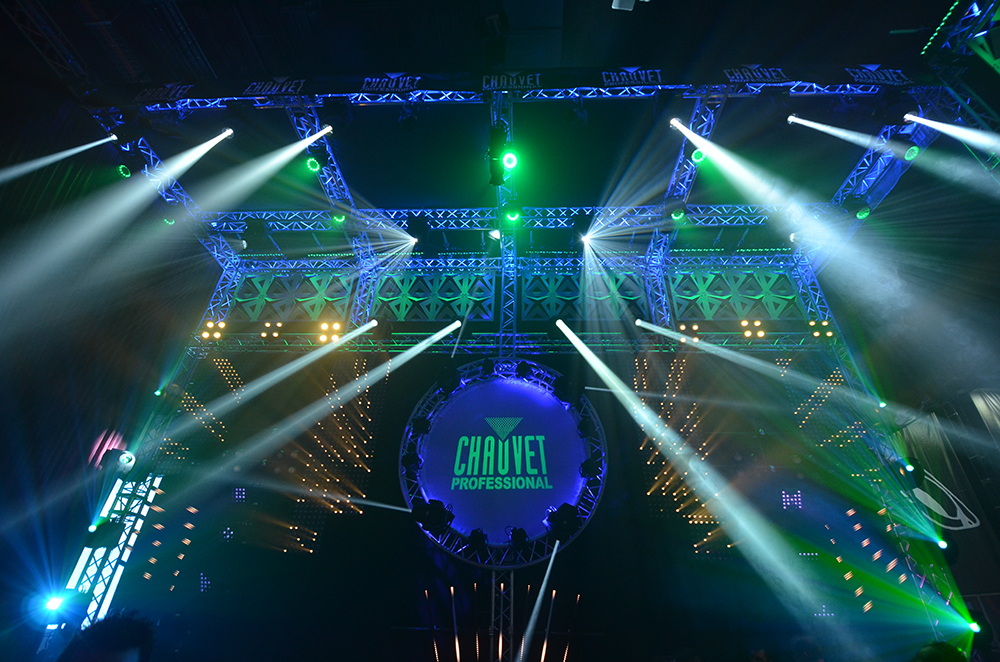
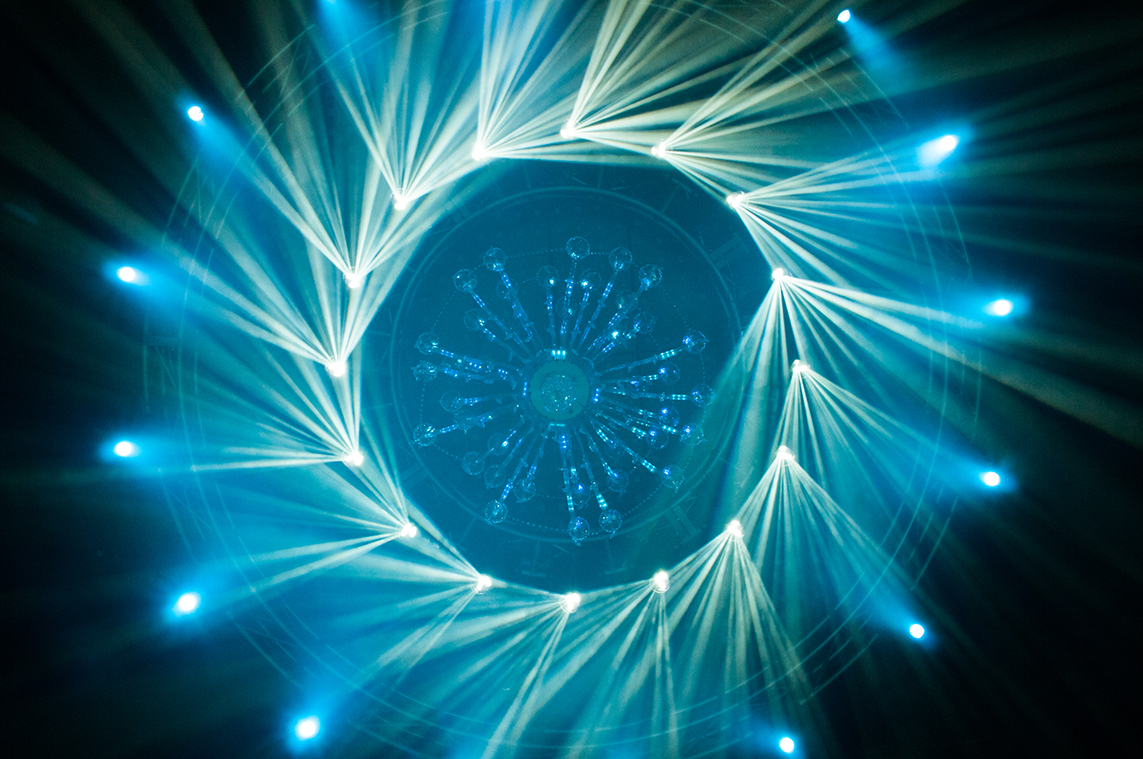
    This image is from our WYSIWYG design of LDI 2015. This is the circle truss that was in the center of our booth
    This image is from our WYSIWYG design of LDI 2015. This is the circle truss that was in the center of our booth.

    Once you have all of your fixtures placed, you need to go back and number them. The method that I use for this is a combination of fixture ID numbers, DMX addresses, and IP when we are using Art-Net enabled fixtures. On my plot, you will typically see three things, the name of the fixture, its ID number and its weight. OK, I am going to stop right here…. Why do we add in the weight of the fixture to the plot? Well, I do it to try to make my riggers life a little easier. The riggers have to calculate weight loads per point. If I include the weights of the fixtures, it saves them a lot of time, and their time is not cheap… Now back to our regularly scheduled article… I always start my ID numbers with Truss warmers. I number the truss warmers first because they are always the first lights that go into the truss and I typically use DMX universe 1 for all of my truss warming. This does two things – 1 all of my truss warmers are in numerical order from upstage to down stage. They are also in DMX order from upstage to down stage. This makes pixel mapping them much easier for the designer. Once this is done, I continue labeling fixtures ID numbers in a linear manor from upstage to down stage from stage right to stage left. I also try to keep my DMX numbers in the same configuration. This way, I do not have to run multiple DMX universes to the same areas of the truss. This minimizes confusion during load in.

    "ThisThis is from our CAD file for LDI 2015. This image shows our numbering of the fixtures. The Fixture number is in blue, which will be for universe 8 the name of the fixture is in magenta and the weights are in black. The red lines are our power runs, which we will cover in an upcoming blog.

    I use a separate document that has more details related to the fixture addressing, ID number, type and any notes that I need to communicate to the load in crew.    After that is done, I then print out two sets of labels.   One set is attached to the truss, the other is attached to the fixtures. This makes it much easier on site to know which fixture goes where. Also, if we have to replace a fixture during load in, the DMX address information is right at the fixture location.

    circle truss stickers


    The stickers contain all of the information that is needed to make sure that the right fixtures are in the right places.  Universe 8 is designated as blue, the DMX addresses are present, along with the fixture ID numbers, and finally the type is also shown.

    Making the final product look like what is in your imagination is the best part of the challenge.

    Making the final product look like what is in your imagination is the best part of the challenge.


    As I have said before, a good design starts with good planning. You should always be thinking about how the show will load in while you are designing it. The whole key is consistency and communication.  Keeping your fixture labels consistent between all of your documentation will save you a ton of time on site and will make your crew’s life much less stressful.


    It’s LDI Time Again!

    October is one of our favorite months.  Fall baseball (go Cubs!),  football is back in full swing,  the leaves are changing amazing colors, there is a crispness in the air, and it is apple cider season.  Oh, and its LDI time!

    That’s right, LDI is just around the corner.  Las Vegas is about to get a dose of entertainment lighting professionals that it has not seen since, well… last year.  The Las Vegas Convention Center is about to get transformed into a maze of lights, haze, and madness that would make Jimi Hendrix envious.  We here at CHAUVET Professional have been getting ready for LDI for quite a while now.  Not only have we designed a very cool booth for the show, but we are also launching some extremely hot new products. For those of you who are coming to the show, please make sure to not only come in the booth and check out our products, but also say hi!  We are always happy to see our friends at the shows and get some in person face time.

    For those of you who will not be coming, we are sorry that we will not see you, but make sure to  to check out the videos and pics from the show that we will be posting on Facebook, Twitter, and Instagram during the show, then on the blog after the show is over.

    So, for a sneak peak at what’s new at CHAUVET Professional, Check out these videos –