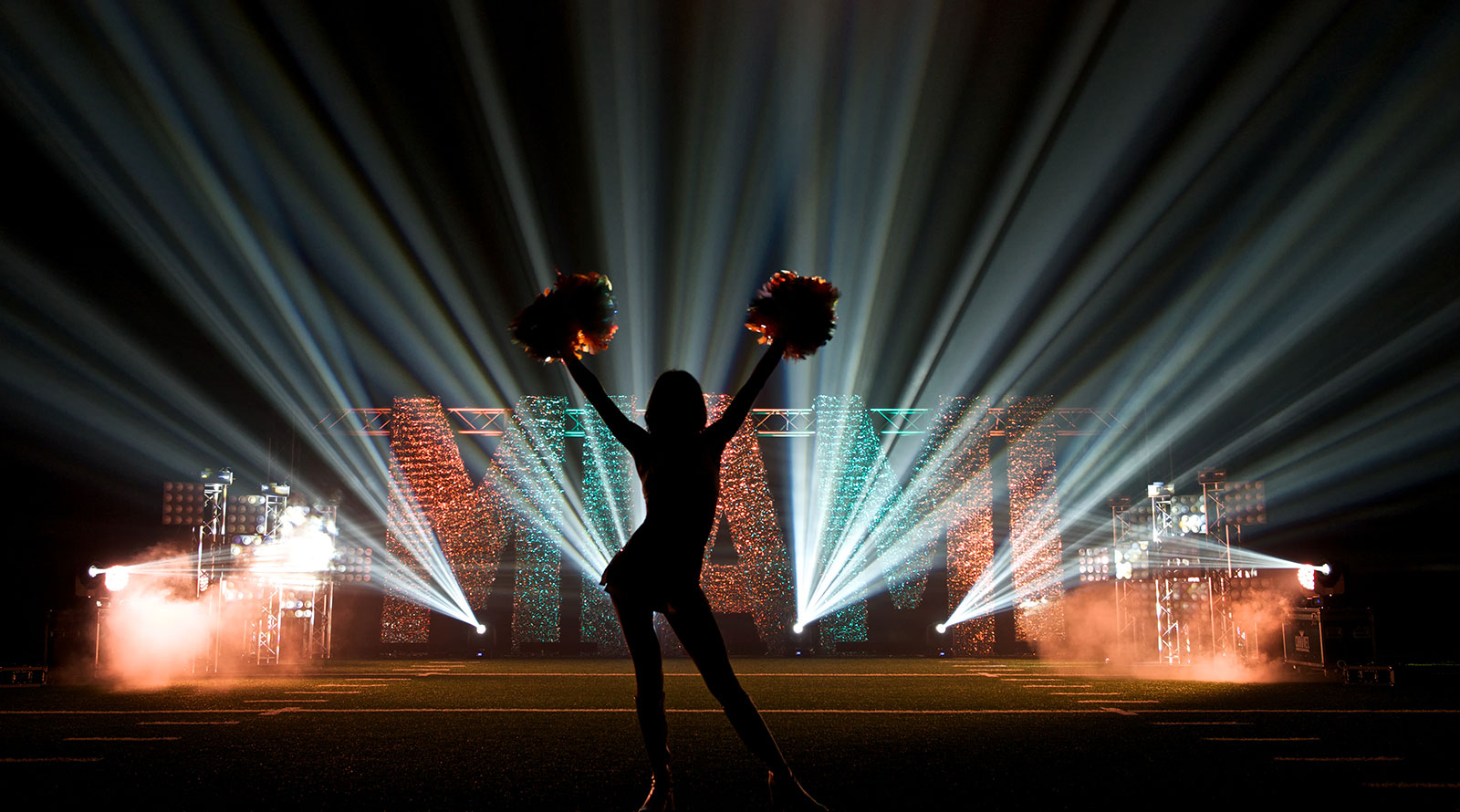
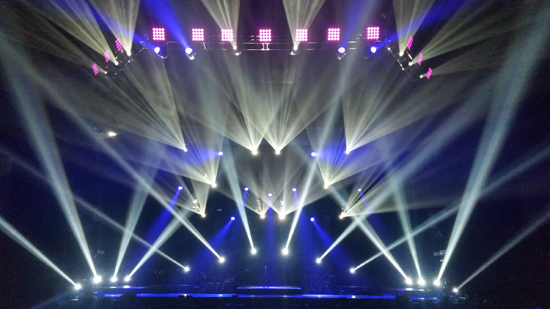
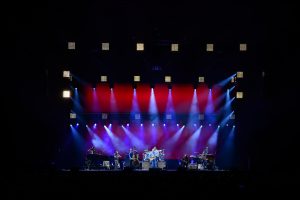
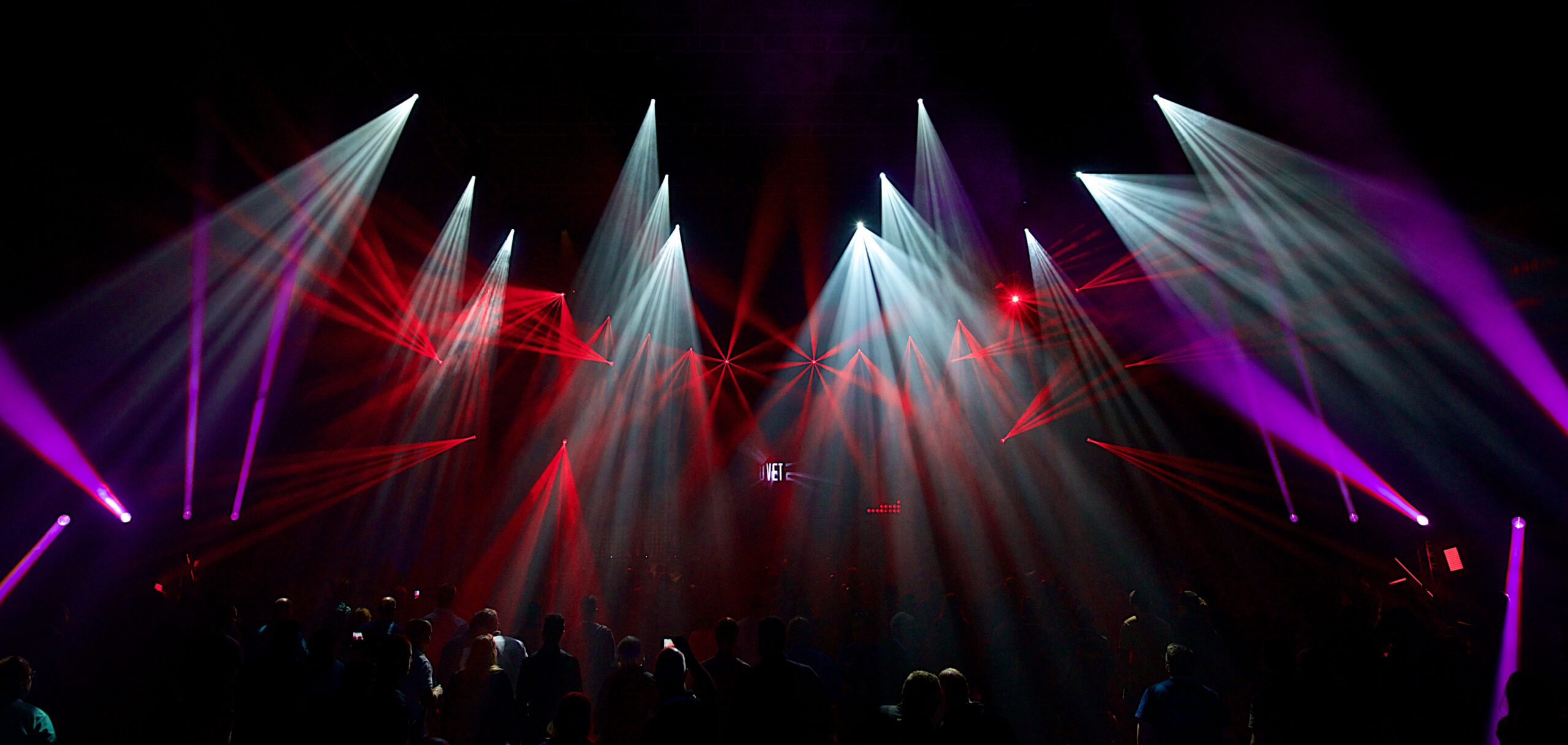
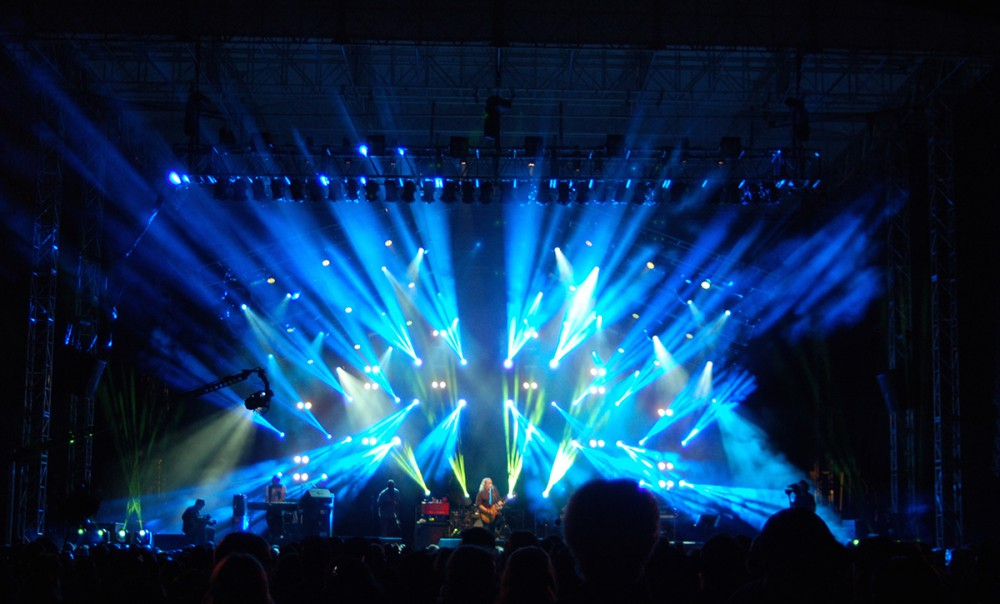
Want to expand your video display, but can’t make the investment in a gigantic wall? No worries, you can still get a big video look without a big investment by mapping the appropriate fixtures with video content so they work with your panels to immerse an entire stage. Chauvet Europe’s Sam Bowden shows how it’s done in this informative video.
One of the trickiest things to do when running a show is keeping time to music when you are trying to not only run cues, but also call spots. The biggest problem is that not only are you listening to music, you are trying to anticipate the cues as you either call them or hit go on the console. This can be even more difficult when there are no lyrics to go by.
While nothing can replace rehearsal, here are a few tips in tightening up your timing
1 – Take a video of the rehearsal. Watch the video over and over again till the music is stuck in you head. Practice hitting go and calling your spots in time with the music. This will greatly help you in getting your timing better.
2 – Get the sheet music. If you are working with a band, they will have the music charts available. Get a copy and mark it up with the cues. Write in where the cues go and follow the music. Even if you can’t read music, this can be helpful since the timing of the music is written in the charts. If you are lucky, you will be working with a musical director that will be willing to help you out with this.
3. When you write the cues, put them in places where they make sense. Try to make your cues match to drops in the music and movement on the stage. By doing this, you will be building musical and movement cues to go on. This will make it easier to memorize the locations of your cues and when to hit go.
4. Practice, practice, practice. Make the most of of rehearsal. Listen to the music. Make the cues make sense. Since the cues should be motivated by what is happening on stage, weather it is musically or physically motivated, locating the cues should make sense.
Running shows like this takes patients. There can be a lot of frustration surrounding the design and execution of shows like this. Try to stay above the Frey by remaining prepared and rehearsed.
(Birmingham, UK) Held at Birmingham’s NEC from 12-14 September, the PRO show – sister to the long established BPM show – is the latest trade show to cater to the Professional AV industry in the UK. Exhibiting for the second time, CHAUVET Professional took the opportunity to unveil several new products at its stand. What’s more, CHAUVET’s incredible roster of fixtures could be seen at the centrally located CHAUVET Arena, a club-like area which stimulated great interest among the thousands of visitors.
“PRO was a real success for us,” said CHAUVET General Manager for Europe Michael Brooksbank. “Visitor numbers were up at our stand on last year, and the Arena provided the perfect opportunity to show off some of our best-selling fixtures in their natural habitat.”
Some 10,000 visitors were treated with no less than five new CHAUVET Professional product launches, including: the PVP X3, the STRIKE 4, and the Rogue RH1 Hybrid.
The PVP X3, CHAUVET’s LED display panel featuring a tight 3.9 mm pixel pitch and SMD 2121 black body Tri-Colour (red, green, blue) LEDs, created a big stir among those in the video and visuals industries. With standard illuminance of 1,560 NITS (adjustable up to 2,100 NITS) and wide 130° viewing angle, the PVP X3 delivers brilliant colour reproduction and exceptional clarity at both close-range and far-range distances over a broad spectating area. Ideal for touring as well as permanent installations, the lightweight 8.5 kg (18.7 lb.) panel is easy to assemble into video screens and walls of all sizes. It features magnetic LED modules for easy road replacement, and low power consumption (115W), which allows large sections of wall to be powered from a single circuit.
Another well-received addition was CHAUVET Professional’s multi format white warm LED strobe wash, the STRIKE 4. Featuring four independently focusable 100W COB (Chip On Board) LEDs, the fixture offers great coverage and flexibility, along with smooth 16-bit dimming control for incandescent-style fades. Automated strobe effects make the STRIKE 4 great for use as an audience blinder as well, whilst its individual manual pan control of each LED pod and adjustable PWM are ideal for on-camera applications.
Last but by no means least, CHAUVET Professional presented its new Rogue RH1 Hybrid, a fixture which is taking the much championed Rogue series to new levels. Combining a powerful beam and spot effect in one compact unit, this amazingly versatile light can produce a tight beam angle of 1°-4.5° in Beam Mode, and a Zoom angle of 5°-19° in Spot Mode, for an array of beam size options. Plus, it’s got an added Frost feature for use as a wash effect as well. Powered by a 330-watt 8000K Osram Sirius lamp, the Rogue RH1 Hybrid offers a designer’s “dream palette” of mind-blowing visual effects, including: two layerable prisms (5- and 8-facet); two gobo wheels; and 13 vibrant colours. Two DMX profiles – 25- or 30-channel – give users programming flexibility.
“At CHAUVET Professional, we put a lot of thought into developing products that meet lighting professionals’ ‘wish list’ and offer the performance enhancements and features that our customers demand, so we were very excited to display our latest offerings at PRO 2015,” concluded Brooksbank, “What’s more, we’re exceptionally pleased at the feedback we’ve been getting both about our products and about the show itself, which, in our opinion, has the potential to be one of the most important for the UK market.”
Information Technology for the Lighting Professional
I saw a really cool ad from Verizon that shows a great explanation for how bandwidth works. It shows a bunch of people sitting in a room. They are supposed to represent data. Then a door shows up on a wall. This is supposed to represent band width on the network. Since the door is small, only so much data gets through. In the ad, Verizon is trying to say that with their network, you get a much wider door that will allow more data to get through.
I honestly could care less what network you use to get internet on, so this is not a push for Verizon, but it does play to a point when dealing with networks in lighting rigs. We spend thousands of dollars on consoles and fixtures. We want to build the best possible control system for our TCP/IP network to operate on, so we spend the money where it counts most, right? Not always. Take a look at your network routers and switches. This is where the Verizon ad statement comes in. If you grab an off the shelf network switch or router from the big box store on the corner, you are going to give yourself a small door. Even if it is a gigabite switch, it may not be what you are looking for. For lighting networks where every frame of data needs to get from the console to the fixtures in your rig, you need to make sure that the throughput is high enough to allow this to happen properly. Throughput is the rate of production or the rate at which data can be processed. Your console creates a ton of data that goes down your TCP/IP lines. This is especially true when doing pixel mapping and running several universes of data. Finding the correct network management devices is extremely important.
When purchasing network switches or routers for your lighting system, make sure that the throughput is optimized for maximum band width.
A millisecond early, a millisecond late, you hit GO at the wrong time. You know it, the performer on stage knows it, and unfortunately, so does the sound guy. Inevitably, you get the cold sweat feeling on your back and the knot in the pit of your stomach is growing. You are already anticipating the conversation at the end of the show between you and whomever and you are not looking forward to it.
If you can identify with the above, relax, you are completely human and we have all been there. The key is how to recover. You have to let go of the bad energy as quickly as it came up. You have to remember that this is live and there is no going back, so deal with the present. Move on and keep going. Don’t let one bad cue wreck the rest of your otherwise excellent show.
I am not sure why, but people in our line of work tend to be perfectionists. We accept nothing but the best and are down on ourselves when we deliver anything but. The mark of a true professional is not the mistake that happened, but how we deal with it. There is saying that I have heard often and it goes something like this, “I have messed up way more important shows than this!” The point of this saying is not to belittle the show you are working on, but to give yourself perspective.
So, go forth and produce amazing light shows. Do your best to hit GO at the right time, but don’t be too hard on yourself when you miss it by a millisecond or two.
Design block happens to us all. Knowing how to get past it is really important, especially when the show you are programming is going to happen with or without your amazing light show. For me, this is something that typically happens when I am exhausted, stressed out, or have simply just hit the wall. But instead of talking about the causes, let’s talk about some work around ideas that might help you out when you feel most blocked.
Take a walk – Sometimes it is a matter of getting up from behind the desk and taking a walk. Go outside and get some fresh air. When I was programming on cruise ships I found it really helpful to get up and go outside once in a while and take a break. I found this especially important when we were programming production shows. Taking breaks is good, but leaving the room for a while is even better. This helps you to remember that there is a world outside of the room you are working in. Getting fresh air back in your body and letting your eyes see something besides the desk and your rig can make a world of difference in helping you get past the rough spots.
.
Eat something – When you are programming for long stretches, you can forget to do things like eating. Lack of energy can really do a number on your mental state. Go and grab a snack. However, I strongly recommend not eating at the desk. Force yourself to get up and move. Take a look at the previous point. Sitting at the desk and eating only allows you to grab a quick snack. Taking a snack break away from the desk allows you to re-focus on something completely different from the show you are programming. I like apples because they don’t need to be kept cool, they are easy for your body to break down and you get the energy quickly.
Change the subject – It often helps to let your mind wander and focus on something else because it is easy for our brains to get locked into a loop and block you from getting your ideas out. In these situations, I might check my Facebook to see what else is going on in the world or what is new on the CHAUVET Professional page, or I might listen to music that has nothing to do with the show I am programming. Sometimes it is just a matter of focusing on something different for a while and letting your brain reset to allow the good ideas to come back.
Get some rest – If you are on a longer programming gig, sometimes you just have to save your show and go get some sleep. After 10 to 12 hours of programming, it all starts to look and sound the same. This is a cue that sleep is in order. If you are doing one of those dreaded shows where you load in the day before, program all night, and then have the show the following day, sleep seems like something that you dreamed about last week. I know that last sentence made no sense, but trust me, when you are that tired, it will. Being awake and running for 15 to 20 hours (or more) is not uncommon in our industry. In those situations, I highly recommend cat naps. Find a quiet place and crash for 20 minutes. It does not replace a full night’s sleep, but it is better than nothing. Keep in mind that caffeine and energy drinks do not replace sleep. As a matter of fact, they can make design block even worse.
.
Plow through it – Sometimes, there is no choice but to plow through. No one likes it, but it is a necessary evil and a skill you need to have. In this situation, when you are totally blocked up, but you have to finish, go back to the basics of design. Make sure that your act is lit well with your three point lighting, and hit the dynamics of the music you are designing to. It may not be your most inspired work, but at least the portion of the show you are working on will be done and you can always touch up later. On top of that, sometimes when you are using this method, the elements start to fall into place and your brain will come back to life.
Design block is all in your mind, but since your mind is what is designing the show, you have to find a way to get past it. There are a lot of different ways to do this, but the above are the ones that work for me. I hope it works for you too. If you have some things that work for you, share them with us! We would love to hear from you!
This is the last in the series, but fear not, there will be more coming!
Written by Mike Graham, product manager for CHAUVET® Professional
I can remember sitting in the audience during a show on one of the ships I was auditing. There was a banjo player on stage and he was working on creating a mood. He was trying to create the image of sitting on his grandfather’s front porch in the evening learning how to play the banjo. All of a sudden, every single moving light in the rig started doing a ballyhoo In Technicolor. It looked like a scene from Close Encounters of the Third Kind and I wanted to crawl into a hole and die. The mental image was destroyed for the audience and the banjo player was about as mad as a banjo player can get. The point is that in a situation like this, one can accomplish more with less. More often than not, this applies.
In the above case, I have to think that the programmer simply lost their mind for a minute. Clearly, they were not thinking about the talent onstage. Or how to serve the show best. In a stage show, such as a rock concert, or even on a cruise ship, you have a ton of lights in the rig because you have to be able to create tons of different looks.
A rock show is completely different from the straight play I wrote about before. One of the great things about moving lights is that you can position them wherever you want with the roll of a wheel, a slide of a fader, or a stroke of a key. The basic principles of front, side, top, down, and back lighting still apply. However, now it is ok to add in a little flavor—BUT ONLY WHEN NECESSARY. For a great lesson in this, I highly recommend checking out the U2 concert video for Rattle and Hum. Largely shot in black and white, you can clearly see how certain songs call for strong beams of light to position down onto each member of the band at certain times. The end result is absolutely stunning. Some of my favorite looks are just simple shafts of light coming from asymmetrical positions. I really like to have odd angles coming in from at least two positions. If you have good spot light operators, it is even better!
Moving lights can also lend themselves to becoming an evil temptation. Yep, they move, change color at the blink of an eye, and you can even drop in a gobo. For some programmers, this is like putting a Twinkie in front of the sound guy. Just because a light has a particular function, it does not mean you have to use it every cue. Once I discovered the move-in-black function on the Wholehog® II, it was like someone gave me the key to life. I learned how to use moving lights as a conventional light (conventional lights are lights that don’t move, have one color in them, and are focused to a specified location). Now, I could make these big “statement” looks like I saw in all of these concerts I had seen before. I was also able to effectively use the tools at hand and create a Zen-like state in my shows. It gave me the subtle lighting show that I wanted to have without having distractions. I found that I was much more at peace with the whole process once I figured out that you don’t have to overdo it.
Another important part in the Zen of programming is that you, as a programmer and designer, must be in a place in your mind where you are at peace. You must be clear of mind so that you can make good choices. In order to be clear of mind, you must know what you are programming and for what type of show. Know your act and know your audience. If you are doing a Rush show, go big with big beam looks and excitement. If you are doing something that calls for an intimate design, then that is what you should do…create a mood. Becoming part of the environment is critical to this. (I am not saying to become the lights, but hey, who am I to argue if you do?) The goal should be to feel at ease with your lights. If you watch a true master of design and programming at work, it looks easy. A true Zen master will be so in-tune with what is going on around them that they are completely aware of their surroundings. For me, if I am able to, I will video tape a rehearsal and work from it. This gives me the ability to design and program without the act there if I have to. This way, I don’t have the pressure of having to rush to get my looks down. I also try to be alone. Too often, people who are “just trying to help” will really ruin your Zen thing. Turn off the cell phone, put on your headphones and get into your zone.
Keep in mind as you go, “Does this look natural?” How does the color reflect the mood of the subject? Is the lighting conveying this mood? Should this be a sharp beam effect or diffused? Does this call for a gobo breakup? Do I need a strobe light hit here? Every lighting change must be motivated. I can remember hearing over and over in acting class, “What is your motivation?” Well, what is it? Is there a change in the action that calls for you to write a cue? Did your principal actor just cross from stage right to stage left? Did your band just change tempo? Was there a murder on stage? If the answer is yes, then write a cue. If there is no change in action on stage, then there is no need. I’m sorry, but “Because it’s in the script” typically is not good enough and may need to be challenged. So challenge it. Wisely.
Now go forth, young Grasshopper, there is nothing more to teach today.
Here is part 2 of Zen in the Art of Lighting. Enjoy!
Written by Mike Graham, product manager for CHAUVET® Professional
Question: How many grains of sand are in the desert?
Answer: Not one more than there has to be.
When you are working on your design of your light plot, it is important to not throw every single light you have at the stage…unless it absolutely calls for it. Once the set design is finished, your job is to make it look amazing. The key here is not to go over the top. Too often designers make the error of throwing the kitchen sink at a rig just to have more. This is not the way of Zen. Zen dictates that the design does not have to be stark, but the choices have to make sense.
Plot with Care, Grasshopper.
It is really easy to stray away from the plan during the plotting stage. Firstly, using software like WISYWIG, MSD, or Vector Works makes dropping in lights really easy. So easy in fact, that the temptation to go overboard is strong. For anyone who doubts this, check out the CHAUVET® LDI 2009, 2010, and 2011 rigs. If there is an open square foot of truss, I am dropping a light in. For a trade show, this is important as the point of the rig is to show what the lights do and how they work together. That is the story line for a trade show, however, this is rarely the case in everyday life.
Consider the Performance.
When you are working on the plot, consider the act. Are you working with a smoky blues singer, or are you working on a Fortune 500 gala event. If you are working the blues singer, then having a few down lights, a little front light, and some back light are really effective and will look really cool. If you are working the gala event, then a much bigger rig may or may not be called for. It really depends on the event. Even if you are working on a straight play (a play with no music), there must be a balance. Classic front, side, and back lighting will work perfectly. Cover your acting areas evenly is the key. There is no need for any kind of excessive lighting in these situations.
Get Practical.
So let’s say I am plotting a show that will have a few practicals. A practical is a light on a set that would be seen in day-to-day life, like a table lamp or a wall sconce. It can either be controlled by an actor (bad idea) or by the lighting operator (good idea). Let’s say I have four wall sconces and two table lamps, I also have to light around them with theatrical light. This means that I have to take into account what kind of light the practical will put out in relation to what the design intent is when I place my theatrical lights.
For example, in your house, a table lamp gives off enough light to read by, but not enough to light the whole room. A wall sconce will give off enough light to fill in the places that the table lamp does not. I would use my theatrical lights called specials.
Stay Special.
Specials are names for fixtures that are used to accent a specific thing. In this case, the special is used to give the impression that the practical is brighter than it is. A special is a functional light source, not an area light source. As I select my specials, I would choose soft, diffused edges and try to get the color temperature to come in around 3400 K so that it is a little cooler than the practicals will be. This will allow the practicals to be seen and function, but will allow the theatrical lights to give off enough output to let the action be seen. Combined with the basics of front, side, back, and down light, this will give the action the correct amount of light and will not overpower the light itself.
Check out one of our first ever tech talks from back in 2010 talking about DMX and AMX Hard to believe it, but there are still systems out there using AMX to run their lighting systems. We have come so far with the proliferation of Art-Net, ACN, and SACN since this was written, but still, its all relevant.
Written by Mike Graham, product manager for CHAUVET® Professional
Mike Graham pensive in front of MVP™ video panels.
1. What is AMX? More commonly known as Multiplex or Analog Multiplex, AMX 192 was devised to multiplex up to 192 analog dimmer levels down a four-wire cable. There are thousands of installations that still utilize AMX protocol because the dimming systems they were plugged into were built like Mack Trucks and endured.
2. The transition to DMX. Boxes to convert DMX into AMX were developed in order to avoid problems with the control. As technology began to become less expensive and started to filter into the lighting world, a new protocol was needed to handle larger dimming racks and moving lights. DMX-512 superseded AMX 192, but it came with its own sets of headaches. No standard existed in how DMX protocol was delivered to fixtures. Each manufacturer had its own method. This left smaller companies that made basic dimming and control in the lurch.
3. What is MPX and why use it? Several manufacturers began to use a system called Multiplex – a touch of both DMX and AMX. Others used their versions as MPX. So here we are with all of these smaller controllers out there with Multiplex outputs sometimes sitting right along a DMX-512 output.
When trying to answer some overwhelming questions such as, “What port do I plug into?”, or “How do I keep from ruining a fixture because multiplex puts current down the line?” follow this simple rule of thumb: if you are using like control with like dimmers, Multiplex is the way to go. If Multiplex is all your controller puts out and you want to control intelligent lights, you need to get a new controller.
This is a re-post from a few years ago. We just re-read it and thought it was fitting for Monday Morning Zen
Written by Mike Graham, product manager for CHAUVET® Professional
“I know nothing, but you know less. Together, we will learn and become Masters.” ~ Michael Thomas, Bartender and friend 1995
When you start working on a show, you walk in a blank slate. You know nothing of what the show will be. Often times, the people who hired you don’t know either. When I started as a bar-back in 1995 at Elwood’s Dixie BBQ in Delray Beach Fla., I didn’t know the difference between a Corona and Cuervo. By the end of my first night I did, right into the nearest garbage can.
By the time I got to work with Mike Thomas, I was already a good bar-back, but I really wanted to be a bartender. I convinced Mike that I would work as hard as I could to prove to him that I could do it. One night after a particularly long shift, he let me in on a little secret. The above quote is one of the most profound things I had ever heard at that time. Keep in mind that I was 21 and was about to become the youngest bartender in town. Mike explained to me that the trick was to become part of the environment over time. I had to let go of any pre-conceived notions that would interfere with what was going on around me—to open up my senses and to anticipate the next action. Eventually, as we worked together, we became Masters of our world. At the end, the key was he hid nothing from me, or I from him.
Entertainment lighting is not that much different. We walk in, as supposed Masters of our craft, to build something from nothing and start from scratch. We must open ourselves up to the harsh cold reality that we know nothing of the pending plan or the outcome. We must also shed any pre-conceived notions that we do. We must not hide anything from others just as nothing is hidden from us. We must know this completely.
During the first production meeting, we must formulate a plan of action. What is the intent of our show? What do we want people to take away from their experience? This must be our guide from start to finish. The show must be an extension of the people who put it together. If it is not, then the show will fail. We have a responsibility to connect with the experience that will become our driving force for the show.
For example, in 2011, CHAUVET® as a company embraced a theme of INfected. For our tradeshow booths at LDI, we showed that not only did we come up with a great set of booths we knew and understood our message so purely and so strongly that we produced a phenomenal show. By virtue of the fact that we made conscious and sub-conscious decisions—completely embrace this theme—we were successful in driving the message.
The key is that one must know, not think, that they have put down the best ideas they have for the show. Then nothing is held back. The designer must have clear vision of what the producer wants to see even if the producer does not. The designer must start to visualize from the first meeting what the outcome will be.
Often times when working with musical acts, I can hear colors for songs. I see melodies as lights moving and patterns shifting from spot to spot on a stage. I start to create visuals in my head that become cues in the show. From these images, I see structures that become the lighting rig. I can see the gobos and prisms interacting with washes of various colors. I can see it all so clearly in my head that laying it out onto a controller becomes a necessity as much as the songwriter must get the words onto paper.
Free from Imagining
“One should not imagine oneself to be one with the eye or independent of it or the owner of it. The same with ear and all the other senses, including the mind. Nor should one imagine oneself to be identical with the world or contained in it or independent of it or the owner of it. In this way, free from imaging, one no longer clings to the things of the world. When one no longer clings, there is no more agitation, insecurity, and worry. Being no longer worried, one can reach into the depth of oneself and understand that where there has been lost there is now fulfillment.” ~ “Samyutta Nikaya” of the Buddha
The point is you must free your mind enough to imagine not what your vision is, but rather to know what your vision is. You must see your vision clearly in your mind to open up and let it become reality. When you know your vision doubt, worry, and stress float away because you have the security of knowing.
Now that you know your direction, the next step is to create something.