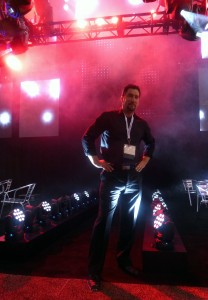
Mike Graham, comfortable in the spotlight.
Written by Mike Graham, product manager for CHAUVET Professional
As a protocol droid, C3P0 is fluent in over 6 million forms of communication. As a lighting industry professional, I feel like we need to be competitive with that number. I’m not saying that we need to be able to speak and understand so many languages, but we should know how to speak to our ever-expanding range of gear.
The beginning of DMX
So, let’s back up a bit. DMX was standardized in 1986. That is to say that USITT required all of the lighting and controller manufacturers to speak the same language of control. All was good in the world (for the most part) as all lighting controllers spoke with all dimmers and lights. This still remains true, as DMX is still the standard. And as a whole, I think that we all speak DMX relatively well. However, it has gotten a lot more complex for the lighting industry professional to just speak DMX, and on just one type of controller.
Disclaimer: If you are lucky enough to be on a sit-down gig and only have to use the (insert console of choice here) to operate the same rig every night, then you can stop reading now. However, if you are planning on doing anything different in your career, then keep reading.
 Accessible software
At this past LDI, I saw something that I never thought I would see. I saw not one, but at least three of the major controller manufacturers release a widget that would allow any user to download some software to their computer for less than $100.00, and to be able to use a full universe of DMX for their extremely professional PC version of the full-size controller. This tells me that the controller manufacturers are coming off the hilltops and trying to win over the masses of users. This also tells me that as one of the mass, I had better learn all of these platforms and speak the programming language well enough so that when I show up to a job, I can easily work any one of these platforms.

Pixel-mapping Nexus 4×4 works with DMX, Art-Net and Kling-Net protocols.
Along with the controllers becoming a little more cost conscious, I have also seen a rise in fixtures that will work directly with Art-Net. Art-Net is essentially the TCP/IP version of DMX. This protocol allows the control platform to output on a total number of DMX universes only limited by the processing power of the controller itself rather than the amount of DMX outputs that are present on the back of the board itself. CHAUVET Professional is releasing its first fixture that will allow direct input of Art-Net: Nexus 4×4. By allowing direct input of Art-Net, building large matrixes of color-changing array fixtures like the Nexus 4×4 becomes much easier. This is because not only do you assign the DMX address to a fixture, but you also assign the universe number. This means that Fixture A can be Universe #3, DMX address #38, and Fixture B right next to it can be Universe #15, DMX address #54, and the CAT5 cable can go directly from Fixture A to Fixture B. There is more to it than that, but again, it is another language that we need to be able to speak.

ÉPIX Series of pixel-mapping fixtures speaks Kling-Net.
Past DMX, we have video languages. At Chauvet we have two distinct languages for video: LINSN and Kling-Net. LINSN is a language that is used to communicate between (in our case), the MVP Media System, the MVP Driver, and the video panels themselves. We use this language as it is designed to transmit huge amounts of information over a CAT5 cable to the video panels themselves. In video control, this is the first part of the communication to make sure that the panels are properly configured. Next is configuring the media server to play back your video content how and when you want it to play. There are a few options for this; do you want to use time code? Then SMPTE or MIDI is the key, if you want to have direct control from your lighting desk, that is an option as well as you can always use Art-Net and in some cases, straight DMX for that purpose. Again, that is a minimum of understanding at least four different languages right there.
 Our second video-based language at Chauvet is Kling-Net. Kling-Net allows matrix configuration of specific Kling-Net enabled devices, such as the ÉPIX Series and the Nexus 4×4 with ArKaos MediaMaster and MediaMaster Express software. Kling-Net is another TCP/IP based software that unlike Art-Net, which uses a static IP address, uses a router to assign an IP address to each fixture. Once the fixtures are addressed and configured in the Kling-Net mapper, you can switch the output back to MediaMaster and have content playing back in no time. Again, a few more languages to speak.
As I have been saying all along over the past several years of Tech Talk, education outside of your comfort zone is really important. I have brought up eight different protocols and languages here, and I didn’t even touch on RDM or ACN, but this barely scratches the surface. The point is that it is critical, now more than ever to be reading, downloading, and playing with different kinds of controllers and protocols every chance you get. The lighting world is no longer just lights and hasn’t been for a long time. And I can guarantee you that it is just going to get more and more complex.