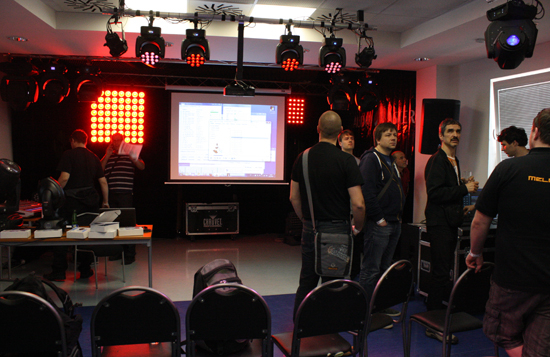
    Tech Talk: Know Before You Show

    Mike Graham comfortable in the spotlight.

    Mike Graham comfortable in the spotlight.

    Written by Mike Graham, product manager for CHAUVET Professional.

    Since my son was born 6 years ago, I have had a lot of experience with “some assembly required,” then having to show him how to use the thing that I just spent way too long building. Reading the manual helps a lot with situations like this, and also having some time to play with it first before showing him how to use it. Admittedly, sometimes I have a hard time giving up the new toy and letting him play with it.

    I. Read the manual. Reading the manual may not seem like an important thing, but to be honest, it is really important, especially when you are using a fixture you have never used before. The manual will have important information on rigging, operation, power specification and installation. All of this is pretty important when you have your brand new light and you are trying to guess how to hang it, set a DMX channel, or navigate through the menu map. By guessing on how to operate or hang a fixture, you may end up damaging it before you even get to use it. Reading and understanding the specifications of the fixture will also help you to better apply the fixture to a particular situation.

    toy-houseII. Check out the light before the show. Playing with your new light before you get to a show is also a great idea. This will prevent you from having to do on-the-job training and not being able to fully utilize the awesomeness of the fixture. There is nothing worse than walking in to program something, looking up and not knowing the gear that is in the rig, or how to utilize it. I love setting up lights in my living room and getting a chance to see how fast it pans tilts, and what colors look best plastering the walls. It is also a good time to work with a new fixture without any distractions. This is also the perfect time to make sure that the fixture profiles are working properly and that you will not have any on-site problems that could have been caught beforehand.

    instruction-manual-1This is even more important when using multimedia gear like projectors or video walls. Not knowing the ins and outs will add a lot of time into the programming of your show and could cost you future shows with the same people. It is really apparent when you are trying to figure out something on the fly. The sweat dripping off your forehead is a dead giveaway.

    Chauvet provides great documentation including manuals and quick resource guides for all of the products. We also have product videos that show exactly what they can do. This information is available at www.chauvetlighting.com. I highly suggest checking it out, as it is a great resource of information and inspiration for making your show a success.

    LD profile: Jordan Chance

    Six questions with Jordan Chance, lighting designer and owner of Luxe Productions design company. 

    1. How did you get into this field?
    Lighting is something that has been growing within our company and I’m privileged to learn from people within the industry who I really respect.  Lighting caught my interest when I saw how it can dramatically change a space.  I started to feel passionate about it when I noticed that you can take two basic ideas, implement one of them differently and end up with a bigger, more dramatic effect. After that discovery, I started to look for the best possible ways to setup in order to bring fresh ideas to rooms  and obtain the biggest effects.

    2. What do you think is the next big thing in the lighting industry?
    Obviously LED fixtures have changed the lighting industry for the better.  Now that there is so much versatility in effects, the big question is, how to maximize that effect.  I think battery operated fixtures with built-in wireless DMX are awesome and those features help with setup and tear down time.  It would be great to see powerful, LED gobo projector with a temperature control — this would allow for minimal power consumption and pinpointing the proper white to suit the event.

    3. What has been your favorite design/project?
    I love anything that hasn’t been done before.  If it seems ridiculous or really difficult, I am immediately interested. One of my favorite projects this year was lighting Martin Estate.

    4. What was the biggest unforeseen obstacle that you’ve faced in one of your designs, and how did you overcome it?
    We recently lit an event at a beautiful, spacious venue with tons of character. They have an amazing custom floor that we did not want to damage, so had to run DMX and power throughout the ceilings and walls to get our fixtures where they needed to be.  It required a scissor lift, took a lot of time, but when we finished, there weren’t any visible wires and it looked awesome.

    5. Complete this thought: A show without light is like…
    A show without lights is like no presents on Christmas day — disappointing.

    Legend 230SR Beam Shows Off in Chauvet Showroom

    Eight CHAUVET Professional Legend 230SR Beam moving yokes gave an amazing performance in our very own showroom at Chauvet headquarters in Sunrise, Fla. Our Video Production Specialist Todd Murray did a great job on the improvised stage and tried to steal show, but he was unsuccessful—sorry Todd, the beams are just too awesome! Here are some photos that speak for themselves:

    Legend-showoff-2
    Legend-showoff-1
    Legend-showoff-4
    Legend-showoff-3Legend-showoff-5Legend-showoff-7Legend-showoff-6Legend-showoff-8

    Educating a Brighter Future, Part 2

    frank dankoMy Journey in Lighting
    written by guest blogger Frank Danko
    [ED: Mr. Danko’s journey began at an early age and in an earlier blog post. Here the journey continues.]

    back stageTheatre is everywhere.
    My passion for technical theatre continued through college where I studied theatre arts and worked freelance around New York. I ran lights and sound for weddings, mitzvahs, concerts, dance events, corporate events and theatrical productions. It was at this point I learned that I didn’t need to be in a theatre to be a technician. Events took place everywhere from parks, hotels, churches and right on the streets. One day I would be sitting behind the console in a hotel and the next day I would be setting up staging on the streets of NYC. Theatre was everywhere and I learned as many lessons on the job as I had sitting in the classroom.

    A career begins.
    I decided to pursue my passion for technical theatre because it seemed like a natural transition. I worked in a local theatre for several years, which lead to a position with our local IATSE production rental company who was providing gear for Broadway and Off-Broadway. After joining the organization, I came to find out that we were also providing lighting and audio at local schools. I was immediately interested in this side of the business because of how meaningful my educators were to my journey. I began meeting with teachers, directors and facilities managers to see how I could assist in their production needs. We developed a program where IATSE Technicians would go into schools to do workshops with students on lighting and audio. This program allowed me to help solidify the future of our industry by paving the way for students interested in pursuing a career in technical theatre.Ovation at booth

    The education continues.
    I am proud and fortunate to teach workshops in the New York area as often as possible and I sit on the board of the NYS Theatre Education Association. I represented CHAUVET Professional and showed the Ovation series at The Hemsley Lighting Programs 9th Annual Lighting Portfolio Review this past March at Lincoln Center. This program honors Gilbert Hemsley, a highly regarded designer who dedicated his life to mentoring and educating young talent in the lighting industry. The Hemsley Lighting Program offers master classes and portfolio reviews by the industry’s leading designers in an effort to foster and educate the future of our industry. I have been fortunate enough to attended USITT numerous times, Broadway Lighting Master Class and was pleased to join the CHAUVET Professional’s team at the 8th Annual Stage Lighting Super Saturday at LaGuardia School of the Performing Arts this past January.

    USITT studentsArt transforms people’s lives!
    Theatre is a collaborative art that cannot exist or grow without dedication from those who will follow in our footsteps. At the USITT Stage Expo, CHAUVET Professional helped to inspire young technicians who walked the floor as I once did. With this in mind, I encourage you to get involved with USITT, EdTA and your local organizations promoting theatre education. Join me in helping us to educate a brighter future. You might just learn something in the process.

    Inspired to learn more? Please feel free to contact me at [email protected].

    Educating a Brighter Future, Part 1

    frank dankoMy Journey in Lighting
    written by guest blogger Frank Danko

    Editor’s note: Mr. Danko was recently at Chauvet HQ for a training session. While here, he shared a quick, yet passionate speech about the benefits of USITT and theater education in general with the group. We were so taken with it that we asked him to write a post as a guest blogger. And here it is…in two parts. Enjoy!

    I am not an educator in the formal sense of the word, so please forgive my grammar. However, what I do is certainly educational for those I am fortunate enough to meet in my travels. As the theatrical lighting representative at BMG Hudson Sales & Marketing (NY/NJ), I have the great pleasure to educate customers and colleagues alike on the quality products manufactured by CHAUVET Professional.  My lessons certainly do not Desks in an Empty Classroomtake place in a classroom, my lessons come alive in offices, theatres, venues and the occasional bar. As lighting professionals, we must be in constant pursuit of knowledge to grow with our industry and further the development of those around us.

    Never stop learning.
    Many of us have not been in the classroom setting in quite some time, but we remain eager to learn in our professional lives. Through educational organizations, such as the United States Institute for Theatre Technology (USITT), there are wonderful programs for aspiring technicians and seasoned veterans alike. Since 1960, USITT has been dedicated to the growth of our industry and the education of our future technicians. Its commitment to our future has developed new technology allowing our industry to adapt in this ever-changing world. I sincerely hope you were able to attend the recent USITT held in Milwaukee, Wis. I was not able to attend, but it did remind me of my personal journey in lighting; one that I’m proud to share with you in this blog post.

    But what do you do?
    A few years ago, while hosting a workshop on lighting design for high school students, I was asked, “what does a theatrical technician do?” I have spent the majority of my career working as a technician, but I never asked myself the WHAT question. I thought it was obvious to anyone who has ever seen a show, and so my answer was “We do everything!” The student looked at me sideways and under her breath I could hear her say, “That didn’t answer the question.” In an effort to clarify, I began to list the responsibilities of technicians: we hang, focus and program lights, run cables, call shows, move sets, set microphones, push boxes, hand off props and even dress the talent. I could see she was beginning to understand and like a batten falling from overhead; it suddenly hit me that the WHAT didn’t matter. I never cared what the task was, I was just happy to be a part of something larger than me.
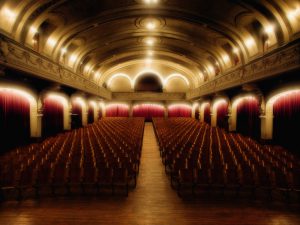
    Empty TheaterThe great white dream.
    As a young teenager, much like the students who attended my workshop, I was eager to learn. At the time, I never thought of pursuing a career in technical theatre, in fact, I was destined to be on Broadway. Growing up 20 minutes outside of NYC, I was fortunate to attend shows from a young age; naturally I wanted to be on stage. It wasn’t until my high school performing arts director asked me to come to “Stage Crew” that my perspective changed. I walked in the auditorium and there were all of these young people just like me, playing with power tools, painting sets, focusing lights and turning microphones on and off. This was a whole different world and I must admit, it was a bit overwhelming at first. It was quickly made very clear by the senior crew chief—this wasn’t rehearsal, this was work. So I began to work, first by helping push the Genie lift around for one of the upper classmen focusing front of house. I asked questions, I listened and followed directions to the best of my ability. At the end of the day my teacher approached me and asked, “Coming back next week?”  To which I replied, “Absolutely!”catwalk
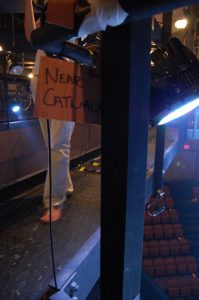
    Soaking up knowledge.
    In my junior year, our school bought a new computerized lighting console. It didn’t operate on AMX like our original board, it was a technology called DMX 512-A, one that I was not familiar with. Like any good techie, I started to research this new console and the DMX protocol and discovered USITT. It is responsible for DMX512-A becoming the industry standard in entertainment lighting. While researching USITT, my teacher also informed me of several great organizations like the NYS Theatre Education Association (NYSTEA), Educational Theatre Association (EdTA) and the International Thespian Society. These organizations were working to make theatre education a priority. This seemed important to me, very important. I became involved with NYSTEA because of my teachers involvement and I attended my first event, right in my own school. There were over 100 students from my region who had the same interests as me and I spent the day taking workshops and soaking up knowledge.

    Sharing newfound knowledge.
    My teacher informed me that USITT would be hosting a conference in Pittsburgh, Pa., later in the year. I asked my parents if I could attend, they were reluctant but took a friend from stage crew and myself to the event. I saw all the exhibits, played with equipment and even programmed my first intelligent fixture. I walked the show floor for hours, met industry professionals and listened intently to everyone I encountered. It was an amazing experience and I couldn’t wait to tell my teacher and classmates about it.

    The journey continues. Click here to read part two.
    Inspired to learn more? Please feel free to contact me at [email protected].

    Legend 230SR Beam Steals Bollywood Show in Birmingham

    CHAUVET Professional fixtures gave a lively performance during the Bollywood Extravaganza show at the LG Arena in Birmingham, U.K. Sixteen Legend 230SR Beam moving yokes shot bright beams on stage and toward the audience, while 12 Q-Wash 560Z-LED wash lights bathed the stage in rich color. New Illumination Lighting Design event and lighting company based in London specified the lights. Here are some powerful images:

    OLYMPUS DIGITAL CAMERA

    OLYMPUS DIGITAL CAMERA

    OLYMPUS DIGITAL CAMERA

    OLYMPUS DIGITAL CAMERA

    Tech Talk: 16-Bit Dimming for LEDs

    Mike Graham comfortable in the spotlight.

    Mike Graham comfortable in the spotlight.

    Written by Mike Graham, product manager for CHAUVET Professional.

    The latest push in the world of LED lighting has been control of said LEDs. Dimming has been a problem since the beginning of LEDs in the entertainment industry and has effectively made it so that it is unacceptable to many lighting designers to use LEDs for anything except scenic elements and highlighting. For some reason, having a ‘steppy’ low end that looks like a flat tire sounds is a bad thing.

    Chauvet has done some amazing things over the past few years with regards to this problem. We released fixtures with built-in dimming profiles a few years ago in the COLORado, COLORdash and Q-Series of products to help with the visual version of ‘thump thump thump,’ and that helped a lot. Doing a fade from 50% to 0 over a few seconds now looked a lot smoother. The bar has been raised again.

    Several manufactures (including Chauvet) are introducing 16-bit LED dimming, which virtually eliminates any remnants of the dreaded ‘steppiness’ that has plagued the industry for years. Chauvet has already released several products with 16-bit dimming included, such as the Ovation series or COLORado 4 IP to name a few.

    Microsoft Word - Document2Sixteen-bit dimming offers the user the ability to easily control LED dimming just like you would control fine pan and fine tilt. As always, there are 255 steps of control in 8 bit (standard) dimming control. With the fine control offered in 16-bit mode, there are 255 additional steps between each step of the standard 8-bit dimmer channel. This additional level of control allows the fixture to act much more fluid in dimming, especially at the low end where it has always been problematic. In the DMX personality, the channels would be set up like in the image at right, in the case of the COLORado 4 IP.


    Microsoft Word - Document2

    If the profile is set up correctly on your console, all you will see is something similar to the image on the left. This is because the person who built the profile has already incorporated the normal operation with the fine control, in the same way that fine pan and fine tilt are included in the parameters for pan and tilt in most personalities. If you could see the values of the 16-bit channel move during a cross fade, you would see the numbers whip from 0 to 255 and back again faster than you could possibly read them. However, if you are using a fader controller, you will still have to use the fine channels for tweaking your color output and is most useful in the very low end of control. What I would suggest is to have the main control at your desired level of output and the fine control at full. I would suggest dragging the main level to zero during dimming and drag the fine control to zero following the main control. This will give you the best control of the low end in a manual situation.

    As a final tip, in any 16-bit control situation, it is important to turn off any dim setting or dim curve settings. They should be both turned off so that there is no conflict between the controller and the fixture. Keep in mind, those settings were designed to help the fixtures compensate for 8-bit control. As long as you are using a 16-bit personality, your fixture does not need any help on low end dimming.

    Chauvets honored for JM Family’s AAA | Business & Entrepreneurism

    Albert and Berenice Chauvet will be honored for JM Family’s 21st annual African-American Achievers award in the Business & Entrepreneurism category. They join others in a rich history of celebrating those who “unselfishly invest their time and talents toward building a stronger South Florida community.” In preparation for the awards ceremony, held April 18, 2013, the Chauvets participated in a video interview conducted by members of JM Family team which took place in the showroom at Chauvet headquarters.

    Below are some behind-the-scenes photos of the video interview shoot.

    Chauvets inteviewed in front of CHAUVET  Professional VIP video products under a full Chauvet rig.

    Chauvets interviewed in front of CHAUVET Professional VIP video products under a full Chauvet rig.

    Chauvets getting miked in front of CHAUVET  Professional VIP video products under a full Chauvet rig.

    Chauvets getting mic’ed in front of CHAUVET Professional VIP video products under a full Chauvet rig.

    JM Family crew setting up in front of CHAUVET  Professional VIP video products under a full Chauvet rig.

    JM Family crew setting up in front of CHAUVET Professional VIP video products under a full Chauvet rig.