LD Profile: Rodney Daniel

    Six questions with Rodney Daniel, executive producer for Runway Images, Inc. of Atlanta, Ga. 

    1. How did you get into this field?
    After years of providing models for events and fashion shows, one time I was asked to actually produce a fashion show. After my first show I was hooked.

    2. What do you think is the next big thing in the lighting industry?
    Being able to run lighting from apps on our smartphones or iPads. Currently I use ShowXpress and the LIVE app on my smartphone.

    3. Do you have a favorite fixture (and why)?
    Yes any of the CHAUVET Q-Spot fixtures with gobo capabilities, along with real-time reaction from the board.

    4. What has been your favorite design/project?
    The annual Bauder Black Tie Fashion Event and various events for NBA ALL-Star Game weekend.

    5. What was the biggest unforeseen obstacle that you’ve faced in one of your designs, and how did you overcome it?
    Being told by a venue that we cannot use truss system or rigging for an event, and we had to place all lighting on staging and floor.

    6. Complete this thought: A show without light is like…
    …having a Rolls-Royce without gas!

    CHAUVET Professional ÉPIX Fixtures Rock with Luke Bryan

    Once again, CHAUVET Professional performs flawlessly in a high-profile tour: 130  ÉPIX Strip and 16 ÉPIX Bar fixtures are used for their pixel-mapping abilities in the vivacious design for Luke Bryan’s Dirt Road Diaries Tour 2013. The ÉPIX Strip and ÉPIX Bar lights have an imposing effect above a video wall on stage and above the audience from a square-shaped truss. The CHAUVET Professional lights were controlled via ArKaos Kling-Net protocol, for fast and easy assignment. Here are some great shots:

    Luke-Bryan-blog-4

    Luke-Bryan-blog-1

    Luke-Bryan-blog-5Luke-Bryan-blog-3

    Luke-Bryan-blog-6

    Luke-Bryan-blog-2

    Nexus 4×4 Spins with C2C in France

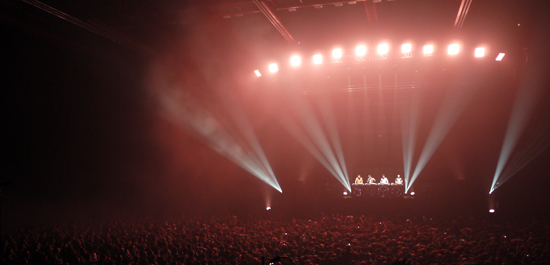
    French turntable group C2C recently performed in Dijon, lit by 12 CHAUVET Professional Nexus 4×4 pixel-mapping fixtures. The lights were mostly used as audience blinders and were the most powerful on stage, designed by Cyssous and Cyril Prat. C2C won the Disco Mix Club World Team DJ Championship four years in a row, 2003–2006, and also won the ITF team championship in 2006.

    Chauvet-c2c-blog-1

    Chauvet-c2c-blog-2

    Chauvet-c2c-blog-3

    Chauvet-c2c-blog-4

    Chauvet-c2c-blog-5

    Tech Talk: LED Lights, Camera, Action!

    Mike-new-blogsize

    —Mike Graham comfortable in the spotlight.

    Written by Mike Graham, product manager for CHAUVET Professional.

    Over the past few years, we have covered a really wide range of topics. I don’t think we have ever covered video lighting.  So, with no further ado, we proudly present, [insert drum roll here] … lighting for video.

    There are a few commonalities in how we approach this subject. It’s all about angles and elevation. Without even talking about fixtures, let’s approach positioning first.

    I. Know your angle: 

    There are three major types of lighting in video:
    Key lighting — In an ideal setting, I would suggest getting your key lights (front lights that cover the subject being lit) at about a 20-degree angle above the subject and about 45 degrees off to each side of the subject. This will minimize the shadows on the front of your subject. Key lighting is the business side of video lighting; it makes up for the brightest lights in the room and are only there to highlight the subject.

    CHAUVET Professional COLORado Zoom WW Tour

    CHAUVET Professional COLORado Zoom WW Tour

    Fill lighting — For fill lights, (side and back light that is used) angle higher (45 degrees plus to the top and 20 to 30 degrees to each side.) Fill light is less intense than key and often will have color in it. Fill light is used to give the subject depth and is the more artistic portion of video lighting.

    Scenic lighting — is what is used to light up the set (same as in theatrical lighting). Scenic lighting is totally up to you, but don’t make it too bright as you want to make sure you don’t have to bring up your key light so much that your subject is burning up, or more importantly, the video director is not telling you to dim stuff down because all he can see is white glow on his monitor.

    II. First steps for your design:

    This is where I would start a design: much like in theatre lighting, you can divide up your stage area where the video is being shot into acting areas, and then create your lighting plot accordingly. Again, like theatrical lighting, video lighting is all about building a lighting position and repeat. This is why a TV studio looks like a lighting showroom. Each person who is sitting on a news set has his/her own key and fill lighting.

    CHAUVET Professional Ovation E-190WW

    CHAUVET Professional Ovation E-190WW

    Tips for practical applications — When it comes to the more practical applications like corporate meetings, the common setup is to have a speaker in the middle of a raised stage between two projection screens. In some cases, there is a projection screen in the middle of the stage, as well. In these cases, you have a few obstacles in the way of your lightshow. You have to keep all of your key and fill lighting off of the screens and on the presenter, which shouldn’t pose a problem as long as the presenters stay at a podium in the center of the stage. A little front light, a little side light, a little back light and away we go. However, what if you have a “wandering target”?  Let’s say that you have someone who likes to walk and talk at the same time. How do we light that and keep our projection screens clear of any ambient light? At this point, sidelight becomes more important. We will have to raise our front light up to about a 35-40-degree angle and use more side light. Fresnel-style fixtures with barn doors are great for this application. You can cut off the light from the upstage side and flood out the front. Your sidelight will act as your fill in this case and should keep your presenter in good light no matter where he/she wanders. With regards to your front light, you just need more of it. I would suggest using ellipsoidal fixtures for this application. The beam is very directional and you can shutter-cut the upstage side to keep the light off of the screens. When you have your front lights all in position, you may want to throw them slightly out of focus so that the edges of each fixture even out with each other and prevent hotspots. To be honest, it is almost exactly how you would light a dance recital.

    CHAUVET Professional Ovation F-165WW

    CHAUVET Professional Ovation F-165WW

    III. Know how to color:
    So now we have a little information about positioning of lights and some suggestions about what kind of lights to use. What about color? What are my best bets for making all of this blend together and come out looking professional? Front light, as we have discussed is all about the cameras getting what it needs. Most cameras like warm light (3,100K-4,000K) depending on the camera. CHAUVET Professional Ovation E-190WW and Ovation F-165WW offer a 3,150K light source and it is possible to cool them down a little if needed with a correction gel. Another source of white light is the CHAUVET Professional COLORado Zoom WW Tour. This fixture has tunable white colors that can be adjusted anywhere inside of the typical range of warm white. It can also be zoomed from a tight to wide angle to assist with coverage if needed. For side, top, and backlight, it is very common to use more color in them.

    CHAUVET Professional Ovation C-1280FC

    CHAUVET Professional Ovation C-1280FC

    Again side, top, and backlight are all types of fill light. The main purpose of these light sources is to add definition to the subject that is being lit.  Since you are blasting them with front light, your subject will be flattened out. The fill light needs to be just bright enough to add some definition to the subject that you are lighting. Personally, I like to keep it natural. A combination of warm ambers and cool sky colors is a really good way to make sure that your subject stands out; just keep it diffused and not too bright — just enough light to make your subject look natural. Scenic lighting is just that. It makes the scenery look better than it did when it came off the truck. Simple uplighting and some strategically placed gobos will  do the trick most of the time. It is amazing what you can do with a six-pack of WELL 2.0 battery-operated wash lights and two Ovation E-190WW fixtures with break up gobos installed.

    IV. Remember your people:
    Now that we have our lights positioned, focused and colored, we have to work more with the camera people. The first thing that they would probably do after they set up is a white balance on their cameras. This is the time when they will ask you to turn your front lights up to full. They will put a white sheet or something of that nature in the middle of the stage and adjust their cameras to the light that is reflecting off of the white material. This sets the camera iris and color sensors so that when they shoot, the subject does not get blown out and look like a ghost onstage. This is particularly important for live applications where there is no way to correct the images in postproduction.

    By now you should be fairly set to run your show. Keep in mind that it will look too bright onstage for your taste in most cases. However, for the people who are shooting video, this is just perfect!

     

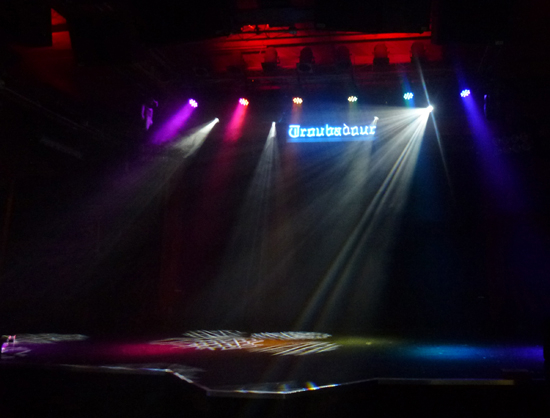
    CHAUVET Professional Lights Serenade at the Troubadour

    The popular Troubadour Club in West Hollywood, Los Angeles, entertains crowds with talented performers and quality lighting provided by Chauvet. Artists and bands such as Elton John, Guns’n’roses, No Doubt, Metallica and more started their careers at the Troubadour. Chauvet lights include six CHAUVET Professional Legend 412 pixel-mapping moving yokes, four COLORado Batten 72 Tour linear lights, four Q-Spot 560-LED moving spots, four COLORado Zoom Tour wash lights and more.

    Chauvet-Trou-blog-1

    Chauvet-Trou-blog-2


    Chauvet-Trou-blog-3


    Chauvet-Trou-blog-4


    Chauvet-Trou-blog-5

    One-on-One with Rasheen Williams

    Rasheen Williams, a member of the Chauvet team for almost eight years, is the customer service manager at Chauvet. Read on and get to know a little bit more about him. IMG_4549

    1. Where are you from?
    I was born and raised in Miami.

    2. Why Chauvet?
    I was introduced to lighting at my previous job and chose Chauvet because of my growing interest in it. Because of my audio engineering background, and since audio has always gone hand-in-hand with lighting, my transition from audio into lighting was pretty easy. My favorite part of the job is helping our customers achieve their vision when it comes to creating their light shows. We address any questions or concerns they may have along the way, in order to help them meet their goal.

    3. Where did you work prior to joining the Chauvet team?
    While working towards my audio engineering degree at S.A.E. School of Audio Engineering, I was the Floor Supervisor at Power Carpet Cleaning. I went on to work for Everlast Productions where I set up audio and lighting for events.

    4. Favorite food?
    I would have to say chicken Parmesan and pasta garnished with sun-dried tomatoes. Add some garlic bread, a great Caesar salad, some Beringer White Zinfandel and call it a meal.

    5. Favorite type of music?
    As a musician, I listen to every single type of music. In my massive music collection, you will find everything from jazz, hip-hop, R&B, funk, Neo-Soul, rock ‘n’ roll, pop, country, classical — the list goes on and on.

    6. Favorite thing to do outside of work?
    I enjoy video editing, as well as writing and producing music. I am a big movie buff, so you can also find me on my couch watching movies from Netflix with my wife and kids.

    7. What is one thing about you that people would be surprised to learn?
    I produce music and videos professionally, as well as play drums. Because of these skills, I was able to pay my way through audio engineering school.

    8. A show without lights is like…
    A dull carving knife going against a Thanksgiving turkey — it ain’t going to cut it!

    LD Profile: Rachel Miller

    Six questions with Rachel Miller, lighting designer at Kinetic Lighting company from Southern California. 

    1. How did you get into this field?
    I started in musical theatre my sophomore year of high school, and I didn’t get into the show “The Fantasticks.” I begrudgingly accepted the role of light board operator, which immediately translated into designer. I fell in love with it then and there on my Lep 624 console. Soon after, my high school opened the new theatre and I had real lekos and a bigger console to play on. I decided to go to Emerson College in Boston for lighting and began working at Kinetic Lighting as a summer internship when I was home. Fell in love with the ephemeral nature of event lighting, and after working for a few other companies in Boston and Los Angeles, got my degree and started full time at Kinetic Lighting.

    2. What do you think is the next big thing in the industry? 
    I think the next big thing is more of an improvement than something new. Once LED fixtures are fully able to replace conventionals [dimming curve, output, etc.] then we have something great and energy-efficient on our hands.

    3. Do you have a favorite fixture (and why)?
    The CHAUVET COLORado 1-Tri Tour has served me well on every single show I have specified it on. It can function as an uplight, a narrow beam or a wash light when I put a Source Four PAR lens in the gel slot. It is multifunctional and I’d be happy to see them on any show.

    4. What has been your favorite design/project?
    My favorite design was for the Drew Carey “Price is Right” wrap party in 2011. We worked with Inna at Poko Events and came up with a design to fit her Studio 54 theme. James Schipper and David Jacobi designed the intricate truss layout, which was all ground-supported circles broken into pieces to create a wave-like perimeter around the party. This gave me multiple structures to light off of, and since it was two stories tall with go-go dancer decks on top, I had tons of options. I researched Studio 54, called my dad to get the inside scoop from a New York attendee, and hit the drawing board. I used ColorBlaze fixtures vertically on the truss and had them do a section chase very similar to the cyc light chases at the club back in the day. I toned every piece of truss with COLORado 1-Tri Tour lights, giving me the ability to change the entire atmosphere with its saturated, punchy colors, and threw a mix of Mac 2000 and Mac 301 lights to do beams swooping across the party. It was a darker atmosphere, and the two-story truss and dancer platforms really alluded to what the club was like in the ‘60s.

    5. What was the biggest unforeseen obstacle that you have faced in one of your designs, and how did you overcome it?
    One of the bigger obstacles was walking into a ballroom with a full rig and light plot in hand, and being told the house manager gave us the wrong rig point drawing and all the points we thought we had were actually a different ballroom. We had a one-day install out of town and ended up having to ground support everything and make it work with what we could get our hands on. Lighting artwork in the center of that ballroom on flats was a challenge, but screwing in PAR 20s to the flats, using battery-powered photo lights and having just enough ambient light did the trick.

    6. Complete this thought: A show without light is like…
    …radio.

    Photo credits: 2me Studios 

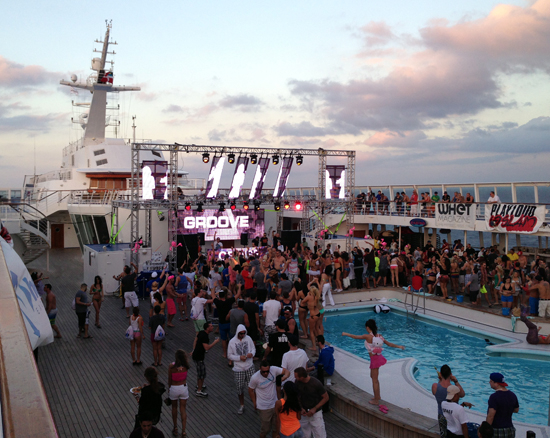
    MVP 18 Video Panels Groovy on The Groove Cruise

    The Groove Cruise experience got hotter with the addition of 162 CHAUVET Professional MVP 18 video panels, used at the beach, on the pool deck and at the Stardust Theater, on the Norwegian Sky ship of Norwegian Cruise Line. Operations Manager for Advanced Concert Productions Collyns Stenzel specified the gear and designed all stages, while  Production manager Tim Cabral ran the production coordination. Jason Buekema is the person behind The Groove Cruise, created for dance music aficionados and to bring together the world’s best dance music artists.

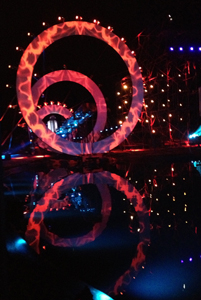
    CHAUVET Professional Lights ‘Wipeout’ Reality TV Show

    About 200 CHAUVET Professional fixtures from the COLORado series of wash lights brighten up the elaborate outdoor set of “Wipeout” reality game show. Contestants have to compete in what is billed as the world’s largest obstacle course, which is now lit by 100 COLORado 1-Tri IP lights and 86 COLORado 1-Quad IP and  COLORado 1-Quad Tour fixtures.