    Blog Series: Lighting Education

    Tech Talk: Keep Your Movers Moving

    Mike Graham comfortable in the spotlight.

    Mike Graham comfortable in the spotlight.

    Written by Mike Graham, product manager for CHAUVET Professional.

    Broken lights are a nightmare. Moving lights are more so because they are complex machines that seem to never break down in an easily accessible location. Unless you have a magic wand in your toolbox, you will encounter broken moving heads somewhere in your lighting life.

    An ounce of prevention:

    Firstly, in order to try to keep lights from breaking, preventative maintenance is a great place to start.  Developing a regular schedule of checking under the covers will help you head off problems before they come up. I typically suggest a quarterly inspection for normal usage, if you are on a tour or in a club situation, then a monthly inspection may be a better plan. A few things to check for are the following:

    Check belts. Are all of the belts tight enough and do they look worn at all? Belts should look almost like new all of the time. They should not show any signs of ripping or fraying. To make sure that they are tight enough, you should be able to twist them 90 degrees with a little force, but not much more than that. If the belt won’t turn at all, it is too tight, if it just spins to 180 degrees, it is too loose. This is a good rule to go by.

    q-wash-436ZCheck fans. Are the fans clean? If not, you can use an air hose, but make sure that you are not allowing the fans to free spin with the air hose. While it sounds cool, you are causing major damage to the fan and to the driver PCB that the fan is attached to. Free spinning fans causes electrical feedback to the PCB and will damage the brushes inside the fan itself.

    Clean optics. Is there any gunk buildup on your colors, prisms, lenses, or gobos? Cleaning your optics is important because you lose a ton of light when your effects are dirty. I strongly suggest using a lint free micro fabric cloth to clean off all of these components. Also, do not spray anything onto the colors or gobos. Spray the cloth. This will help to prevent spots on your optics, and also prevent overspray into the rest of the fixture.

    Check connections. Are all of the wire harnesses properly connected? Make sure that everything is plugged in tight and that the cables are not crimped in anything.

    Clean the base. Is there any dust build up in the base? This is especially common in night clubs. Fans suck in everything from hair, to smoke, to confetti. This tends to build up on top of the power supply and main PCB. Make sure that you clean all of this garbage out of the base. This will extend the life of your power supply and main PCB greatly. Remember that these items are really expensive to replace out of warranty.

    Taking the above steps will really help in extending the life of your investment.

    boxes-load-inLoad in check out:

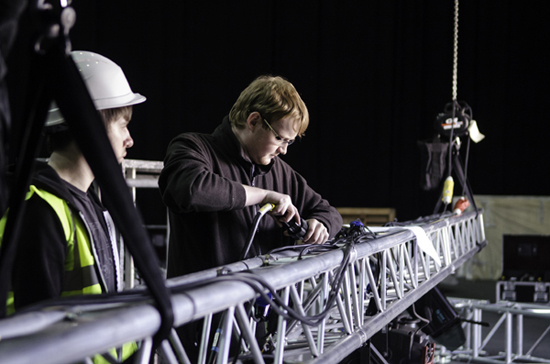
    So, it’s 6 a.m. and your coffee has not kicked in yet, but nonetheless, you are at load in. This is when you have your last chance to check your lights before you put them someplace where a problem is going to be harder to deal with. When you take the fixture out of the case, look at it. Make sure that none of the covers look out of place. Make sure that they are also on tight. Give the fixture a little shake and listen for any kind of lose items rattling around inside the fixture. Now hang it on the truss. Plug it in and run it. This is also a good time to make sure that your pan and tilt locks are off. Even if you do not have data run to the light yet, you can check the functionality of the fixture itself. Typically, if the fixture homes properly with no error codes, it is good to go, but I like to take it one step further and make sure that the lamp turns on (if it is a discharge light) and that the shutter blades open. If it is an LED fixture, run the virtual dimmer and shutter to full to make the LED come on. In both situations, you should see a bright white light and no gobos, colors, or prisms in the field. As only as you only see a bright white light, you should be in good shape. If you can add data, this is even better so that you can make sure that you can control everything. I also like to keep checking everything as the rig is going up. A ton of things can happen to your lights during their trip up to trim. Keep an eye on your gear as it moves.

    Q-Spot 560-LEFTAnd then, the inevitable happens:

    So, something broke. Now what? Typically there are symptoms of problems. For example, let’s say that you have no control from the console to the fixture, but the fixture works fine in test or stand alone mode. It could be a bad cable or a loose connection. It could also be that the fixture is in the wrong personality, the address is wrong. On the controller side, it could be a few things there as well. Did you just update firmware in your console?  In that case, the personality could be wrong in the console. The patch could be messed up, Are you using Art-Net? There could be a problem in a router or your Art-Net to DMX box could be behaving badly. I like to check the micro issues before I check the macro issues.  The above is the order that I would check this kind of problem. Each one is quick in of itself, but depending on your crew, could take a few minutes to check. When you find out what the problem was, write it down. Keep a log of every issue you have. Eventually, you will have a database of problem solving. When I worked on ships, I kept a log of the problems that I had in each showroom. This way, when I moved on to my next ship, the incoming lighting person would have something to start with. An entry might look something like this:

    rig-moving-heads“Aug. 16, 2001 — fixture X needed lamp replacement. When the fixture was opened, not only was the lamp bad, but the base of the lamp had shattered inside of the holder. I removed the base of the lamp and found that the porcelain in the socket was cracked as well. I replaced the lamp socket. As a tip, make sure that the brand of lamp does not change. The bi-pin base of the lamp can change slightly from manufacturer to manufacturer.”

    Keeping notes like this can be tedious, but can and will save you time in the future. It also helps greatly when you are on the phone to technical support. The person you call for technical support genuinely wants to help you with your problem. They are going to ask you questions such as:

    • Where are you located?
    • Do you have a phone number and e-mail address to reach you?
    • Are you on a show right now?
    • Is the fixture still in the rig?
    • What kind of controller are you using?
    • What kind of power are you using?
    • How many fixtures do you have power-linked together?
    • How many fixtures do you have data linked together?
    • Are you using an opto splitter?
    • Are you using Art-Net?

    Knowing the answers to the above will be really helpful. Especially if you are either on a show at that moment, or are away from your lights that you are calling about.

    ldi-setupSafety first:

    If you are having any kind of mechanical problem with a light, you need to unplug it from the rest of your rig immediately. Not only power, but data as well. A bad fixture can cause you data problems up or down the line. If for some odd reason there is a bad enough problem, it is possible to get a voltage spike in the data cable that can cause your opto splitter to fry, and if you don’t have an opto splitter in line, then your console is in danger. (This is why I ALWAYS have each universe of DMX isolated with an opto splitter between the console and the first fixture) If you do have a light that is down and it is 30 feet in the air, leave it there until it is safe to actually get to it. Don’t just go climbing up the truss to replace it. Keep a rope in your road box that is long enough to pull a fixture up and drop it down. I keep a pulley in my case for this as well. If something seems like a bad idea before you do it, most likely it is.


    CHAUVET Professional Animates Performances in Ciudad de Mexico

    About 20 CHAUVET Professional fixtures lit the stage for various performances at a Jewish Center in Ciudad de Mexico. Lighting Designer Yonathan Mendelsberg of Lomas Eventos used 16 Q-Wash 560Z-LED wash lights and two Legend 300E Beam lights. More CHAUVET DJ SlimPAR Tri 12 IRC fixtures washed the stage in vivid colors.

    Centro-Judio-blog-1

    Centro-Judio-blog-2

    Centro-Judio-blog-3

    Centro-Judio-blog-4

    Centro-Judio-blog-5

    CHAUVET Professional Radiates at Entech in Australia

    CHAUVET Professional made a statement at the ENTECH 2013 trade show in Sydney, Australia, displaying bold fixtures with distributor Showtools. Our stand featured luminaires from the Ovation series of theatrical lights, COLORado line of wash lights, Nexus 4×4 pixel-mapping wash, Q-Spot 460-LED moving spot, Q-Wash 436Z-LED and more. Chauvet’s ILUMINARC brand of architectural and architainment lighting was also represented by a selection of indoor and outdoor fixtures.

    Entech-blog-pro-2

    From right, Showtools’ Robert Runko, Melissa Runko, Arian Yeganeh and Chauvet’s International Sales Director Stéphane Gressier.

    Entech-blog-pro-1

    Tech Talk: “On Tour: Tait Stages” or Watchable Reality TV

    Mike Graham comfortable in the spotlight.

    Mike Graham comfortable in the spotlight.

    Written by Mike Graham, product manager for CHAUVET Professional

    I was flipping through the guide a few weeks ago and stumbled on a reality show that cannot possibly be staged. Reason being: it’s all about building stages. “On Tour: Tait Stages” gives a pretty realistic view of what goes on from planning a show all the way to the first few load ins. The AXS TV website describes it as “a documentary series following the employees of Tait Towers and its clients with a behind-the-scenes peek into the world of designing, building, and touring stage sets.”

    While I have never tried to pull off anything as complex as what Tait Towers does every day, I can find this show easy to relate to as the process, no matter the scale of a show, is still the same. As I consider myself an industry professional, my wow factor is set pretty high—I am not easily impressed. However, I can freely admit how extremely impressed I am with how this show is put together. The access that Tait Towers allows the camera crew is pretty stunning.
    Tait Towers Bon Jovi Hexs

    Without revealing any top trade secrets, I think it is cool that they show as much as they did during the planning stages of the Bon Jovi “Because We Can” tour. Specifically, the scenic design going through revision after revision while trying to get elements built so that the build process would not fall behind. Without ruining the ending for you, they did succeed. As for budget, well, they never brought that up.

    During the Madonna “MDNA” load in, they showed how they label their scenery carts. They not only have their logo on it (so you can see who it belongs to), but also its stage location, the items that are on the cart, as well as a 3D CAD rendering showing how the items on the cart go together and how they are used in the final assembly. For me, this one bit of insight was worth watching the whole show.

    It was really cool to see how the different teams of designers, fabricators, accountants, MP900402515and clients all work together. It is extremely apparent that there are major stressors at play during the filming.  Deadlines do not change, even when the plans do. Problems come up in the real world, and they have to be dealt with before they get out of hand. Watching someone else deal with these never-ending issues is a great learning experience for all of us.

    This show gives us an inside look at the touring industry from an insider’s point of view. While watching, I am taking away from it as much useful information that I can. For someone outside of our little world, it is good entertainment and should make people realize that the show does not appear from nowhere.  It takes time and effort to make it look awesome. It is also vindication to anyone whose parents told them there is no money in rock and roll.

    For anyone with an interest in this industry — and I would assume that you do, as you are reading this technical tip — I would strongly suggest checking this show out:

    ON TOUR: TAIT STAGES – Bon Jovi’s “The Hexes” – Part 2 from Dialogue Pictures on Vimeo.

    Tech Talk: No Effect Before Its Time

    Mike Graham comfortable in the spotlight.

    Mike Graham comfortable in the spotlight.

    Written by Mike Graham, product manager for CHAUVET Professional.

    Building up anticipation is a powerful tool. You hear it in music with the lead up to a crescendo, you see it in a suspense movie, you read about it in great works of literature. But…you are supposed to also see it in lighting.

    I. Start small, go bigger:
    One of the things about a great light show is to create a sense of anticipation in the audience. The key to this is to not give away all of your tricks in the first 10 seconds of the show. Take your time. Bring in effects slowly over the course of a show. I’m not saying to make the beginning of your show boring. On the contrary, make it dynamic with moving heads with sharp focus and no gobos positioned at contrasting angles. Use your static fixtures in primary colors. If you are using video panels, keep the content basic. As the show goes on, start adding in effects slowly. Add in gobos to the movers, start using mixed colors in your pars. Always hold something back to be used at the right moment. Having spinning gobos and prism wheels for the entire show is going to get really old quickly for the audience; however, using it when it makes sense is really effective.

     VeeLounge-sp2II. Effective effects:
    Adding effects when the time is right is really important. If a song does not call for a strobe effect, don’t use it. You have to make sure that your design ideas make sense. For example, having massive color changes and your moving heads in an offset can-can for a dramatic slow song is a really bad idea. However, you can do a nice blue stage effect with some red or purple overtones — this will look really nice. Add in a few break-up gobos on the backdrop and now you have something really sweet. If you are covering “Pinball Wizard,” then having the movers going crazy with massive color changes makes perfect sense.

    VeeLounge-sp1III. Cue structure:
    Cueing is really important. Or at the very least, make sure that you know what material you are lighting, so that you know when to make a change. For the lights to match the subject you are lighting, you have to have motivation from the stage colors to change. I’m not saying that the cues have to be predictable, but if your talent is standing stage left, making the lights move to stage right is not a good idea. You have to wait for the time to be right. Hitting “go” at the wrong time can really mess up a show. This is particularly true for magic acts, acrobats, and jugglers. If you mess up one of their cues, it could mean a trip to the hospital. Again, anticipation of a lighting change is a powerful thing. You are creating an imaginary experience for the audience. It is up to you to accent what is happening on the stage. The light has to convey the right message to the audience and it has to match the action on the stage.

    VeeLounge-sp3All in all, the idea of good lighting is to make sure that something that is happening on stage motivates you to create a lighting look. Using that motivation will ensure that you have created a design that will make the audience appreciate the show that you have worked so hard to design. Let the show content guide you in your design and you will almost never be wrong.

    Tech Talk: Know Before You Show

    Mike Graham comfortable in the spotlight.

    Mike Graham comfortable in the spotlight.

    Written by Mike Graham, product manager for CHAUVET Professional.

    Since my son was born 6 years ago, I have had a lot of experience with “some assembly required,” then having to show him how to use the thing that I just spent way too long building. Reading the manual helps a lot with situations like this, and also having some time to play with it first before showing him how to use it. Admittedly, sometimes I have a hard time giving up the new toy and letting him play with it.

    I. Read the manual. Reading the manual may not seem like an important thing, but to be honest, it is really important, especially when you are using a fixture you have never used before. The manual will have important information on rigging, operation, power specification and installation. All of this is pretty important when you have your brand new light and you are trying to guess how to hang it, set a DMX channel, or navigate through the menu map. By guessing on how to operate or hang a fixture, you may end up damaging it before you even get to use it. Reading and understanding the specifications of the fixture will also help you to better apply the fixture to a particular situation.

    toy-houseII. Check out the light before the show. Playing with your new light before you get to a show is also a great idea. This will prevent you from having to do on-the-job training and not being able to fully utilize the awesomeness of the fixture. There is nothing worse than walking in to program something, looking up and not knowing the gear that is in the rig, or how to utilize it. I love setting up lights in my living room and getting a chance to see how fast it pans tilts, and what colors look best plastering the walls. It is also a good time to work with a new fixture without any distractions. This is also the perfect time to make sure that the fixture profiles are working properly and that you will not have any on-site problems that could have been caught beforehand.

    instruction-manual-1This is even more important when using multimedia gear like projectors or video walls. Not knowing the ins and outs will add a lot of time into the programming of your show and could cost you future shows with the same people. It is really apparent when you are trying to figure out something on the fly. The sweat dripping off your forehead is a dead giveaway.

    Chauvet provides great documentation including manuals and quick resource guides for all of the products. We also have product videos that show exactly what they can do. This information is available at www.chauvetlighting.com. I highly suggest checking it out, as it is a great resource of information and inspiration for making your show a success.

    Educating a Brighter Future, Part 2

    frank dankoMy Journey in Lighting
    written by guest blogger Frank Danko
    [ED: Mr. Danko’s journey began at an early age and in an earlier blog post. Here the journey continues.]

    back stageTheatre is everywhere.
    My passion for technical theatre continued through college where I studied theatre arts and worked freelance around New York. I ran lights and sound for weddings, mitzvahs, concerts, dance events, corporate events and theatrical productions. It was at this point I learned that I didn’t need to be in a theatre to be a technician. Events took place everywhere from parks, hotels, churches and right on the streets. One day I would be sitting behind the console in a hotel and the next day I would be setting up staging on the streets of NYC. Theatre was everywhere and I learned as many lessons on the job as I had sitting in the classroom.

    A career begins.
    I decided to pursue my passion for technical theatre because it seemed like a natural transition. I worked in a local theatre for several years, which lead to a position with our local IATSE production rental company who was providing gear for Broadway and Off-Broadway. After joining the organization, I came to find out that we were also providing lighting and audio at local schools. I was immediately interested in this side of the business because of how meaningful my educators were to my journey. I began meeting with teachers, directors and facilities managers to see how I could assist in their production needs. We developed a program where IATSE Technicians would go into schools to do workshops with students on lighting and audio. This program allowed me to help solidify the future of our industry by paving the way for students interested in pursuing a career in technical theatre.Ovation at booth

    The education continues.
    I am proud and fortunate to teach workshops in the New York area as often as possible and I sit on the board of the NYS Theatre Education Association. I represented CHAUVET Professional and showed the Ovation series at The Hemsley Lighting Programs 9th Annual Lighting Portfolio Review this past March at Lincoln Center. This program honors Gilbert Hemsley, a highly regarded designer who dedicated his life to mentoring and educating young talent in the lighting industry. The Hemsley Lighting Program offers master classes and portfolio reviews by the industry’s leading designers in an effort to foster and educate the future of our industry. I have been fortunate enough to attended USITT numerous times, Broadway Lighting Master Class and was pleased to join the CHAUVET Professional’s team at the 8th Annual Stage Lighting Super Saturday at LaGuardia School of the Performing Arts this past January.

    USITT studentsArt transforms people’s lives!
    Theatre is a collaborative art that cannot exist or grow without dedication from those who will follow in our footsteps. At the USITT Stage Expo, CHAUVET Professional helped to inspire young technicians who walked the floor as I once did. With this in mind, I encourage you to get involved with USITT, EdTA and your local organizations promoting theatre education. Join me in helping us to educate a brighter future. You might just learn something in the process.

    Inspired to learn more? Please feel free to contact me at [email protected].

    Educating a Brighter Future, Part 1

    frank dankoMy Journey in Lighting
    written by guest blogger Frank Danko

    Editor’s note: Mr. Danko was recently at Chauvet HQ for a training session. While here, he shared a quick, yet passionate speech about the benefits of USITT and theater education in general with the group. We were so taken with it that we asked him to write a post as a guest blogger. And here it is…in two parts. Enjoy!

    I am not an educator in the formal sense of the word, so please forgive my grammar. However, what I do is certainly educational for those I am fortunate enough to meet in my travels. As the theatrical lighting representative at BMG Hudson Sales & Marketing (NY/NJ), I have the great pleasure to educate customers and colleagues alike on the quality products manufactured by CHAUVET Professional.  My lessons certainly do not Desks in an Empty Classroomtake place in a classroom, my lessons come alive in offices, theatres, venues and the occasional bar. As lighting professionals, we must be in constant pursuit of knowledge to grow with our industry and further the development of those around us.

    Never stop learning.
    Many of us have not been in the classroom setting in quite some time, but we remain eager to learn in our professional lives. Through educational organizations, such as the United States Institute for Theatre Technology (USITT), there are wonderful programs for aspiring technicians and seasoned veterans alike. Since 1960, USITT has been dedicated to the growth of our industry and the education of our future technicians. Its commitment to our future has developed new technology allowing our industry to adapt in this ever-changing world. I sincerely hope you were able to attend the recent USITT held in Milwaukee, Wis. I was not able to attend, but it did remind me of my personal journey in lighting; one that I’m proud to share with you in this blog post.

    But what do you do?
    A few years ago, while hosting a workshop on lighting design for high school students, I was asked, “what does a theatrical technician do?” I have spent the majority of my career working as a technician, but I never asked myself the WHAT question. I thought it was obvious to anyone who has ever seen a show, and so my answer was “We do everything!” The student looked at me sideways and under her breath I could hear her say, “That didn’t answer the question.” In an effort to clarify, I began to list the responsibilities of technicians: we hang, focus and program lights, run cables, call shows, move sets, set microphones, push boxes, hand off props and even dress the talent. I could see she was beginning to understand and like a batten falling from overhead; it suddenly hit me that the WHAT didn’t matter. I never cared what the task was, I was just happy to be a part of something larger than me.

    Empty TheaterThe great white dream.
    As a young teenager, much like the students who attended my workshop, I was eager to learn. At the time, I never thought of pursuing a career in technical theatre, in fact, I was destined to be on Broadway. Growing up 20 minutes outside of NYC, I was fortunate to attend shows from a young age; naturally I wanted to be on stage. It wasn’t until my high school performing arts director asked me to come to “Stage Crew” that my perspective changed. I walked in the auditorium and there were all of these young people just like me, playing with power tools, painting sets, focusing lights and turning microphones on and off. This was a whole different world and I must admit, it was a bit overwhelming at first. It was quickly made very clear by the senior crew chief—this wasn’t rehearsal, this was work. So I began to work, first by helping push the Genie lift around for one of the upper classmen focusing front of house. I asked questions, I listened and followed directions to the best of my ability. At the end of the day my teacher approached me and asked, “Coming back next week?”  To which I replied, “Absolutely!”catwalk

    Soaking up knowledge.
    In my junior year, our school bought a new computerized lighting console. It didn’t operate on AMX like our original board, it was a technology called DMX 512-A, one that I was not familiar with. Like any good techie, I started to research this new console and the DMX protocol and discovered USITT. It is responsible for DMX512-A becoming the industry standard in entertainment lighting. While researching USITT, my teacher also informed me of several great organizations like the NYS Theatre Education Association (NYSTEA), Educational Theatre Association (EdTA) and the International Thespian Society. These organizations were working to make theatre education a priority. This seemed important to me, very important. I became involved with NYSTEA because of my teachers involvement and I attended my first event, right in my own school. There were over 100 students from my region who had the same interests as me and I spent the day taking workshops and soaking up knowledge.

    Sharing newfound knowledge.
    My teacher informed me that USITT would be hosting a conference in Pittsburgh, Pa., later in the year. I asked my parents if I could attend, they were reluctant but took a friend from stage crew and myself to the event. I saw all the exhibits, played with equipment and even programmed my first intelligent fixture. I walked the show floor for hours, met industry professionals and listened intently to everyone I encountered. It was an amazing experience and I couldn’t wait to tell my teacher and classmates about it.

    The journey continues. Click here to read part two.
    Inspired to learn more? Please feel free to contact me at [email protected].