LD Profile: Camron Ware

    Six questions with Camron Ware
    Founder of Visual Worshiper, VJ, Light and Projection Designer

    1. How did you get into this field?
    Started at a church actually where we had no budget and I had to get resourceful and creative with lighting and environment design.  I would also travel and do one-off show where I learned the touring industry and now I have my own company that provides lighting and environment design.

    2. What do you think is the next big thing in the lighting industry?
    Brighter LEDs and more of them and the continual blurring between lighting and video. While those might be the obvious answers, it’s the reality.  More efficient light and lamps that do more for less money.

    3. Do you have a favorite fixture (and why)?
    I would have to say my 10,000 watt fresnel out of an old Disney studio – it’s amazing what you can do with one light.

    4. What has been your favorite design/project?
    Last year I lit Joseph and the Amazing Technicolor Dreamcoat for a local private school that puts on big, quality productions.  It was in the round and had about 300 students in the cast and crew.  Aside from 96 ETC PARs, 40 moving lights and about 100 LED fixtures, my favorite piece was the LED light-up coat I built for Joseph to wear during the final bow.  [Video below.]

    5. What was the biggest unforeseen obstacle that you’ve faced in one of your designs, and how did you overcome it?
    It’s less about technical obstacles and more about lack of budget or passion from the people in charge.  Getting people to realize the power and dynamics of lighting can be tough when following creative dreams.

    6. Complete this thought: A show without light is like…just another day listening to the radio.

    Read Camron’s review of the COLORado Batten 144 Tour linear wash light here.

    Joseph and the Amazing Technicolor Dreamcoat video: [youtube=http://www.youtube.com/watch?v=HaRI71DFZUw&feature=channel_video_title]

    Tech Talk: The MVP System in a Nutshell

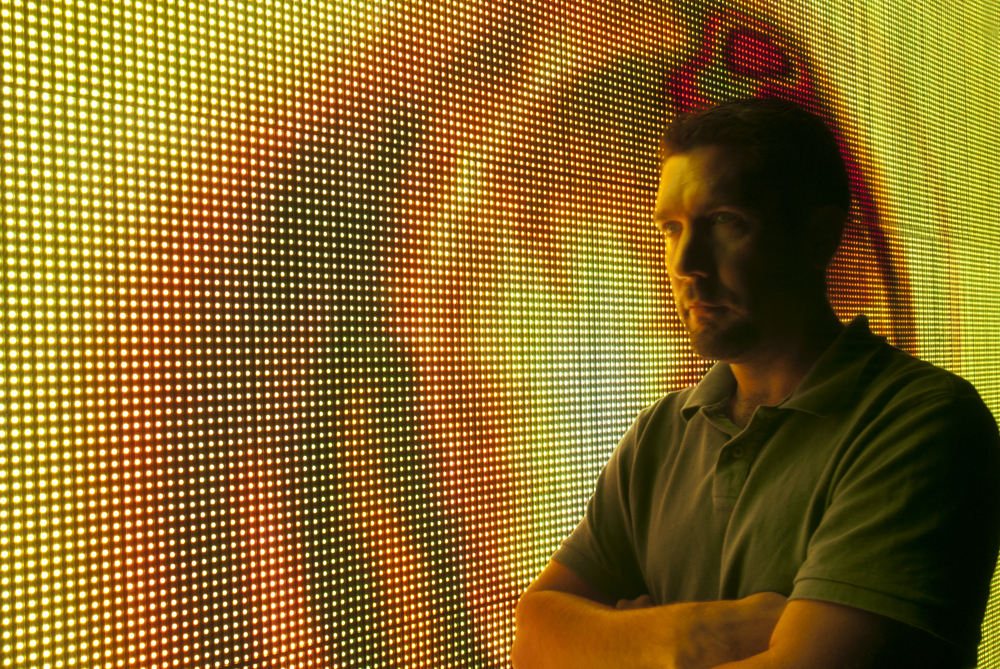
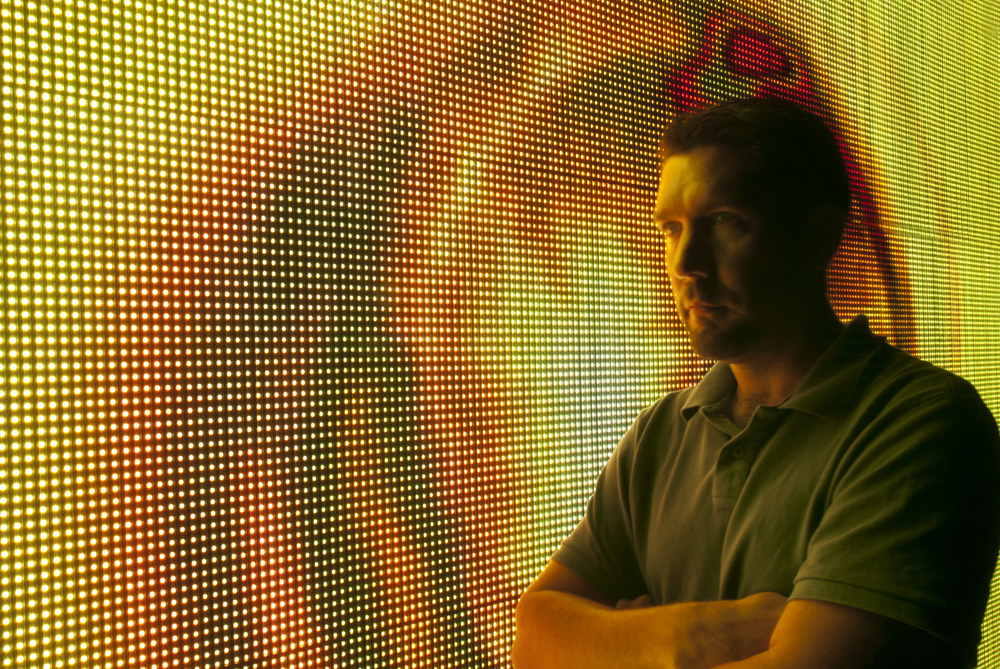
    Mike Graham looking pensive in front of MVP video panels

    Written by Mike Graham, product manager for CHAUVET Professional

    …And there was video, and it was good…

    CHAUVET has entered the video panel world with our release at InfoComm in Orlando this year. MVP Series of modular video panels has already started to buzz right out of the gate. (Honestly, we could not be any happier with the immediate response that we have gotten.) This month I thought I would break down some of the video jargon you will start to see in our literature as well as hear by our sales team.

    MVP installation and operation is actually easy

    Before we get into the video person to lighting person translation guide let me first say that MVP installation and operation is not scary at all. We have taken our time and have made sure to make this as easy as possible. If you ask the crew we worked with at InfoComm, they would pick the MVP panels over lights any day of the week and twice on Sunday. Also, they would rather hang them. This is because they are lightweight, the rigging hardware is easy to use and all of the cabling is done with Neutrik powerCON and etherCON connectors. How simple is that? No strange proprietary connections that you can’t find on the road, just easy to use connectors that are available at any boxed goods store in our fine industry.

    Four concepts of video you should definitely know

    So, let’s say you are new to the wonderful world of video and you want to sound like you know what you are talking about. There are four words and phrases that will go miles into making sure that you get the information you need, that will let the salesperson know that you mean business:

    1. SMD LED – Surface mount diode LEDs are used in the manufacture of the MVP panels. We use these because they are much smaller in size than other LED styles and take much less power to operate. They also have a very wide viewing angle and are very stable in their construction.

    2. Pixel pitch – Pixel pitch refers to the distance between LEDs. It is measured in millimeters. We measure from the edge of the LED because SMD LEDs come in several different sizes. If we measured from the center, it would be a mathematical mess. You might end up with two 18 mm pitch panels with completely different amounts of LEDs.

    3. Viewing Angle – Viewing angle is the area of which the panels can be seen from. This is really important to know when you are setting up your show and you want to make sure that the people sitting in the 400 section can not only see that there are video panels, but see what is on them. The MVP panels have a 140-degree viewing angle.

    4. NIT – NIT is a measurement to video people as LUX is for lighting people. It is defined as follows: the candela per square meter (cd/m2) is the SI unit (International System of Units) of luminance; nit is a deprecated non-SI name also used for this unit (1 nit = 1 cd/m2). The unit is based on the candela, the SI unit of luminous intensity; and the square metre, the SI unit of area. Nit measurement is done at the manufacturing plant and is not something that you can take your handy light meter out and measure. The higher the nit, the higher the maximum brightness of that source is.

    Getting signal to the panels is easy

    Another concern about the MVP system is how to get signal to the panels. Contrary to popular belief, there is no magic wand needed. We implement software that has been created specifically for CHAUVET to manage the signal distribution to the panels. In a basic setup, we send signal from the PC over USB to the MVP Signal Processor and then to the panels. (We will address advanced system setups in future tech tips. Stay tuned!) Once we have all of our wiring done, we configure the software and tell it where the panels are and what kind of layout we have. So for example, if I have six panels wide and five panels high, I create a grid in the hardware setup section of the software that has six panels wide by five panels wide. I then make sure that the software knows what kind of panels are out there, and then I send the configuration file to the panels. In a nutshell, it is as easy as that. All of the settings are done using one software program. There is even a playback section built into the software that is easily accessible and easy to use.

    CHAUVET will be requiring customers come to our worldwide headquarters to attend training on this system prior to using it. We want to make sure we can provide all the tools necessary to you so when you get back to your shop, installation, or wherever you intend to use the MVP system, you have a good handle on it.

    There you have it, the MVP system in a nutshell. For a lot more information, keep checking out our website as we are adding more and more details on this every day.

    To Oslo with Love

    Dedicated to our extended CHAUVET family in Norway. Our thoughts are with you.

    International Travel

    Mike Graham, looking pensive in front of MVP video panels

    Written by Mike Graham, product manager for CHAUVET Professional

    Working at CHAUVET requires I spend some serious time hanging out in the friendly skies. I have had to take my shoes off at some of the worlds finest airports, and have been stuck in the middle seat on more than one occasion on international long haul flights.

    The more and more I do this, the more and more I can identify with Edward Norton’s character from Fight Club. In fact, I think that I passed myself on a moving walkway just last week. So, I am at the tail end of a work trip overseas today and am getting ready to fly out. I am just about acclimated to the time changes, and now get to go back and try to get back to normal.

    There are a few schools of thought on how to deal with jet lag. I think for me, I just try not to sleep on the trans-ocean leg. It seems to work for me typically, but on this one….not so much.

    So, tomorrow, I get back on the big aluminum tube and breath in the same air that everyone else is breathing in for 13 hours or so. Don’t worry, I have my Airborne ready to go. I just hope they changed the movies.

    Next month’s tech talk is going to by my first on video. I am doing a ton of research now and am looking forward to bringing all of you some great information on how to make video part of your show!

    Entertainment Technology is Coming of Age

    Mike Graham, looking pensive in front of MVP video panels

    Written by Mike Graham, product manager for CHAUVET Professional

    The people of the modern entertainment technology industry are coming of age, and getting older. I look around and keep seeing younger and younger faces. I find myself saying things like “I was lighting shows when you were watching GI Joe” and “Back when I started out…..(insert old guy statement here).” I go to shows, see old friends, see them working for a different company, see them getting a new line or wrinkle, and see myself not getting any younger.

    A guy I used to work with passed away this week. We worked together at Barbizon when I first left the cruise ships. I hadn’t seen him in a few years and I knew he was not well, but still you never expect to hear about something like that. I’ve started to see a new addition to the trade magazines that I never thought about before, the obituary section. I now see more RIP posts on Light Network than I would like as well.

    So, to all of us who have been in this business since the 1970’s and 80’s, and still remember lighting controllers that didn’t have any processing speed, get a doctor, get a checkup, and listen to what they tell you. Oh yeah, quit smoking.

    If the shoe fits…

    Mike Graham, looking pensive in front of MVP video panels

    Written by Mike Graham, product manager for CHAUVET Professional

    When it comes to footwear, I am not a brand based person. I have been buying two pairs of value-oriented skateboard sneakers every six months for the past six years. I thought they were comfortable and had enough support for everything I do. This would include everything from working in the office to building trade show booths.

    About three months ago, my wife and I started to hit the gym. This meant going out and picking up some more sneakers. This time, we decided I better get something that was meant for working out. I was trying on different sneakers, my eyes were instantly opened, and more to the point, I realized I have been torturing my legs and back for the past six years.

    My new sneakers. And my tattoo.

    Long story short, I ended up getting a new pair of sneakers for work too. I got a pair of Nike LunarFly+2 sneakers. They are great for standing on concrete all day and more importantly for South Florida in the summertime, lightweight and breathable. Best of all, they were still under $90.00.

    There are a ton of different sneakers out there that are lightweight, breathable, and comfortable. I really suggest getting a pair—for the road, gym, trade show floor, and more.

    Oh yeah, there’s an app for that.  Apple App Store has an app that you can use to count your steps and keep track of you daily “workout” as you go along. Kind of cool.

    Tech Talk: Troubleshooting made easy.

    Mike Graham, looking pensive in front of MVP video panels

    Written by Mike Graham, product manager for CHAUVET Professional

    Everything breaks.
    As John Bender said in The Breakfast Club, “It’s an imperfect world, screws fall out all the time.” I can vouch for this. Not only am I a product manager for CHAUVET, but I have worked extensively in the field. The majority of my field experience was on the water—as in cruise ships. The great thing about working on those ships was learning self-reliance. We did not have a lot of support beyond our own brains and had to troubleshoot for ourselves.

    Searching the internet for answers had to be done from an internet café somewhere in Alaska, St. Thomas, Germany, or an even more exotic place like Miami. We had to be able to think on our feet and figure out stuff for ourselves. We had to take good notes so when we did finally get to a place where we could talk to someone from customer support we had all of the variables figured out. (We typically had only one shot per week to get one of these technical geniuses on the phone.) The funny thing is I can remember the names of every phone technician that helped me and I still run into many of them at trade shows. Some of them have become life-long friends.

    Break down the system.
    Troubleshooting is a critical skill we all need to have, not only in the field, but in the shop as well. The key to fast and easy troubleshooting is to break down the system to its simplest components to see what actually works. For example, if you are working on a moving light and it is not panning or tilting properly, swap the motor cables from the pan to tilt drivers and see if the problem stays with the pan. Or did it move to tilt? If it stayed with the pan, the motor is most likely the problem. If it moved to the tilt, you most likely have a driver problem. Figuring this out before you call the phone support guys will save both of you a ton of time. If it’s a color wheel, you can do the same kind of trick with the cables from the gobo wheel and vice versa. For CHAUVET Professional products, we use the same motor for both positions. It may have a different shaft length, but the motor is the same none the less. Simple things like this will save you a lot of headache.

    Back up a step.
    For a bigger system, it is the same principle: break it down to its basic components. Let’s say you have a club running three universes of DMX from ShowXpress. The last five fixtures on your third universe are not responding to DMX at all. First thing to do is eliminate every non-essential part of gear. Take the DMX cable from the output of universe three to the input of the first fixture that is not working properly. Now all five work, great! Let’s back up one fixture. Now you have six fixtures in line and everything is fine. Let’s back up one more step to the opto-splitter (you are using opto-splitters, right?).  Drop your DMX line from your controller right to the DMX input of the opto-splitter. If the problem comes back, you have a bad channel on the opto-splitter—problem solved. Swap it out.

    Change a cable.
    Let’s say we still have the same lights down. There are six lights on the line coming from the opto-splitter. Fixture one is working fine. The last five are not responding at all. You bypass the first light and find this fixes the problem. First change the cable between the first and second light. (After all, it would not be the first cable that died for no reason.) If this does not solve the problem, change the cable between the first fixture and the opto-splitter.

    The next step is realizing you have a fixture problem. Since most lights send DMX from fixture to fixture without buffering the signal, you most likely have a bad DMX socket. (At least this is where I would start the process.)

    Again, it’s all about breaking down the system to its simplest operation. When you call the technicians at a manufacturer, they are going to ask you if you have already done this. (If you have not, they are going to ask you to do so.)

    10 tips when calling for support.
    You are ready to pick up the phone and call technical support. Make sure you have the following at hand as it will help out the tech immensely:
    1. Serial number of the light in question.
    2. LOT number of the light in question if there is one
    3. What kind of controller are you using?
    4. How many are on the DMX chain?
    5. Are you using an opto-splitter?
    6. How many lights are plugged into one circuit?
    7. How many lights are daisy-chained for power to each other?
    8. What is the power level?  110, 208, or 220 volt?
    9. Is it clean power? Are you on a generator?
    10. How long has it been installed or in operation?

    All of these questions are important for the tech you’re calling (and for you) as it helps to narrow down the scope of the problem(s).  At the end of this process, I hope your problems are solved and that your show is running flawlessly.  If not, “feel free to call us back.”

    BBQ at CHAUVET HQ

    CEO Albert Chauvet helms the grill flanked by managerial staff.

    A great afternoon with delicious food and even better company. Best part? Management cooked for everyone! Check out more photos. Wish you were here!