    Lighting fit for a Queen – Light Show Video!!!

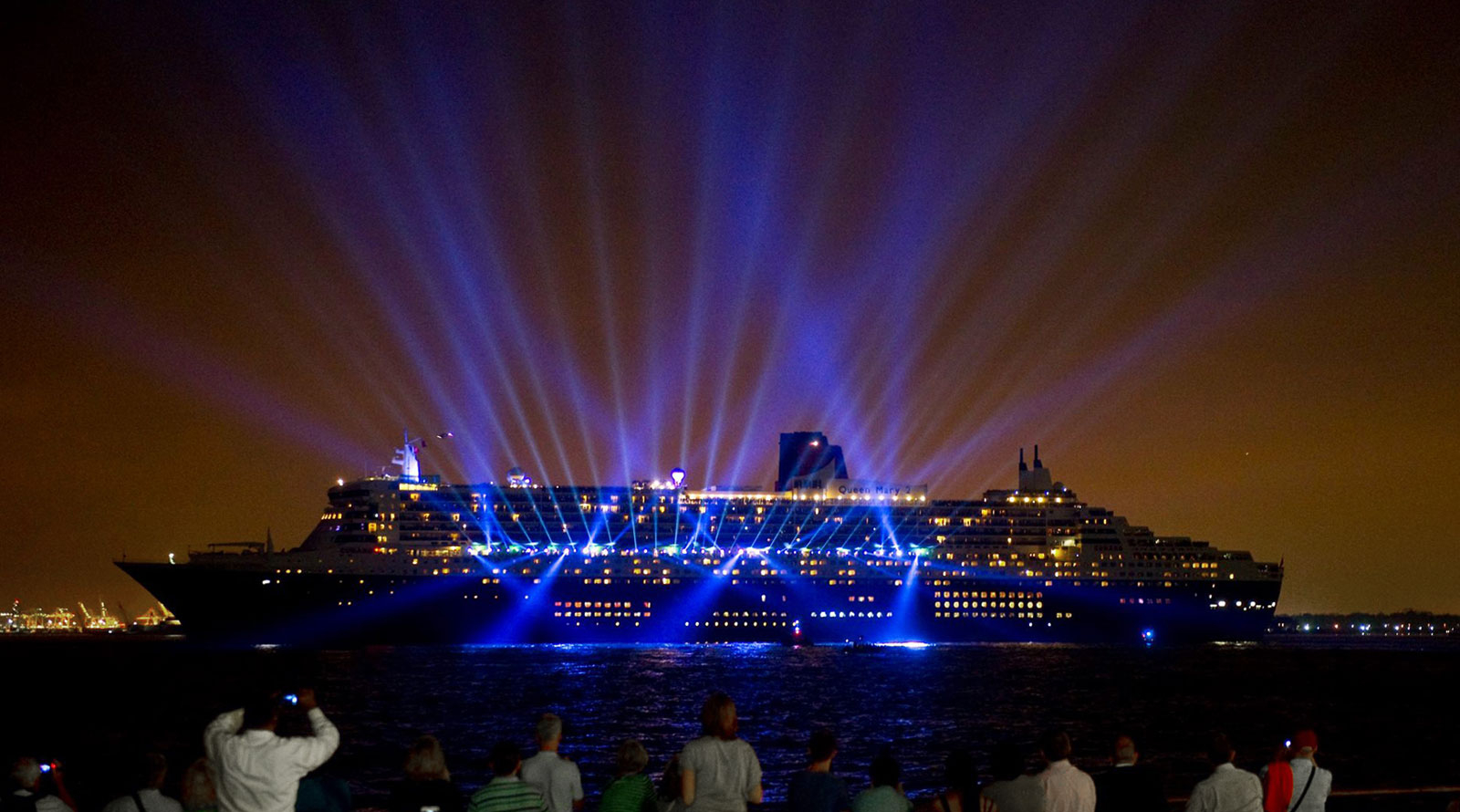
    As we have been discussing the Queen Mary 2 celebration of the 175th year of Cunard’s tradition of trans-Atlantic ocean crossings, we wanted to make sure you actually saw the show so you could see why we were so excited about it.   Check out this amazing show and make sure you have the volume up so you can see and hear every bit of this experience that we are so proud to have the Legend 230SR Beam chosen to be a part of.


    Monday Morning Zen – Zen in the Art of Lighting Part 3

    This is the last in the series, but fear not, there will be more coming!

    Written by Mike Graham, product manager for CHAUVET® Professional 

    I can remember sitting in the audience during a show on one of the ships I was auditing.  There was a banjo player on stage and he was working on creating a mood. He was trying to create the image of sitting on his grandfather’s front porch in the evening learning how to play the banjo.  All of a sudden, every single moving light in the rig started doing a ballyhoo In Technicolor.  It looked like a scene from Close Encounters of the Third Kind and I wanted to crawl into a hole and die. The mental image was destroyed for the audience and the banjo player was about as mad as a banjo player can get. The point is that in a situation like this, one can accomplish more with less. More often than not, this applies.

    In the above case, I have to think that the programmer simply lost their mind for a minute. Clearly, they were not thinking about the talent onstage. Or how to serve the show best. In a stage show, such as a rock concert, or even on a cruise ship, you have a ton of lights in the rig because you have to be able to create tons of different looks.

    A rock show is completely different from the straight play I wrote about before. One of the great things about moving lights is that you can position them wherever you want with the roll of a wheel, a slide of a fader, or a stroke of a key. The basic principles of front, side, top, down, and back lighting still apply. However, now it is ok to add in a little flavor—BUT ONLY WHEN NECESSARY. For a great lesson in this, I highly recommend checking out the U2 concert video for Rattle and Hum. Largely shot in black and white, you can clearly see how certain songs call for strong beams of light to position down onto each member of the band at certain times. The end result is absolutely stunning.  Some of my favorite looks are just simple shafts of light coming from asymmetrical positions. I really like to have odd angles coming in from at least two positions. If you have good spot light operators, it is even better!

    Moving lights can also lend themselves to becoming an evil temptation. Yep, they move, change color at the blink of an eye, and you can even drop in a gobo. For some programmers, this is like putting a Twinkie in front of the sound guy. Just because a light has a particular function, it does not mean you have to use it every cue. Once I discovered the move-in-black function on the Wholehog® II, it was like someone gave me the key to life. I learned how to use moving lights as a conventional light (conventional lights are lights that don’t move, have one color in them, and are focused to a specified location). Now, I could make these big “statement” looks like I saw in all of these concerts I had seen before. I was also able to effectively use the tools at hand and create a Zen-like state in my shows.  It gave me the subtle lighting show that I wanted to have without having distractions. I found that I was much more at peace with the whole process once I figured out that you don’t have to overdo it.

    Another important part in the Zen of programming is that you, as a programmer and designer, must be in a place in your mind where you are at peace. You must be clear of mind so that you can make good choices. In order to be clear of mind, you must know what you are programming and for what type of show. Know your act and know your audience. If you are doing a Rush show, go big with big beam looks and excitement. If you are doing something that calls for an intimate design, then that is what you should do…create a mood. Becoming part of the environment is critical to this. (I am not saying to become the lights, but hey, who am I to argue if you do?) The goal should be to feel at ease with your lights. If you watch a true master of design and programming at work, it looks easy. A true Zen master will be so in-tune with what is going on around them that they are completely aware of their surroundings. For me, if I am able to, I will video tape a rehearsal and work from it. This gives me the ability to design and program without the act there if I have to. This way, I don’t have the pressure of having to rush to get my looks down. I also try to be alone. Too often, people who are “just trying to help” will really ruin your Zen thing. Turn off the cell phone, put on your headphones and get into your zone.

    Keep in mind as you go, “Does this look natural?”  How does the color reflect the mood of the subject? Is the lighting conveying this mood? Should this be a sharp beam effect or diffused? Does this call for a gobo breakup? Do I need a strobe light hit here? Every lighting change must be motivated. I can remember hearing over and over in acting class, “What is your motivation?”  Well, what is it?  Is there a change in the action that calls for you to write a cue? Did your principal actor just cross from stage right to stage left? Did your band just change tempo? Was there a murder on stage? If the answer is yes, then write a cue. If there is no change in action on stage, then there is no need. I’m sorry, but “Because it’s in the script” typically is not good enough and may need to be challenged. So challenge it. Wisely.

    Now go forth, young Grasshopper, there is nothing more to teach today.

    Lush Cosmetics Celebrates 20 Years in Style with CHAUVET Professional

    Lush7


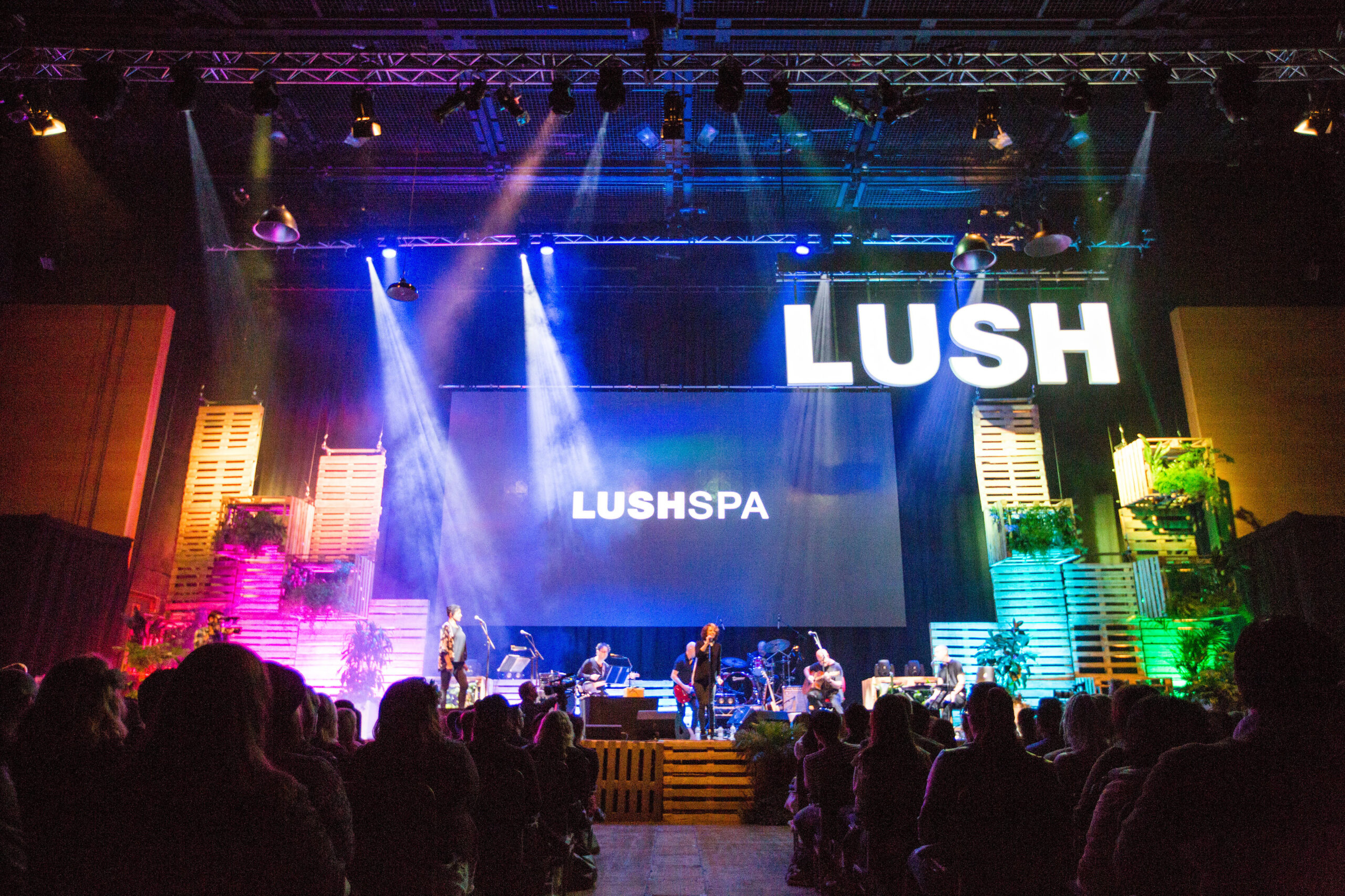
    (Nottingham, UK) Growing from a small local shop to a hugely successful international enterprise in the space of two decades is not easy. Achieving this success while advancing and upholding deeply held ethical principles makes the accomplishment all the more noteworthy. Management at Lush Cosmetics recognized this, which is why they wanted to make their company’s 20th anniversary celebration stand out. That’s precisely what they did, thanks to some help from Presentation Design Services and a collection of fixtures from CHAUVET Professional.


    Lush Cosmetics first appeared on high streets throughout the UK in the mid 1990’s. In the ensuing years, the organic beauty merchant has carved out a well-deserved reputation for quality handmade beauty products, all the while upholding the ethics-conscious principles of fair trade and protecting animal rights.


    In celebration of this 20-year milestone, Lush Cosmetics drew once again upon the support of longstanding event production company Presentation Design Services (PDS) to provide full production support to the event. In addition to designing and building the custom manufactured set, which featured around 200 reclaimed pallets, PDS, as customary, called upon their extensive array of CHAUVET Professional fixtures to empower the event with a magnificent visual aesthetic.

    Lush3

    “Once again, CHAUVET Professional fixtures played a key part in our production design for the Lush Cosmetics event – one of our longstanding clients,” commented James Johnson, Project Manager at PDS.


    With over 2,000 people attending the two-day conference at the BIC venue in Bournemouth, England, Lush required a sizable amount of visual support to create an event worthy of a 20th anniversary celebration.


    “We supplied 254 Chauvet PVP S5 LED panels to create a video wall, which was split into three different screens,” enthused Johnson. “The main central screen played a key part in the set design, consisting of 190 panels, and the two side screens mainly showed live camera feed and VTs to further engage the audience. Thanks to the pin sharp PVP panels, we were able to build quite a spectacle for the Lush presentations.”


    One of the other key lighting fixtures employed by Johnson and his team were CHAUVET Professional Nexus 7×7 panels. Having utilised the Nexus 7×7 fixtures for their sharp warm white focused beams on several Lush events previously, Johnson and his team have certainly found a great tool to create a certain concert-esque atmosphere inside what is essentially a corporate event.


    “The stars of the show were, hands down, the Nexus 7×7 panels,” conceded Johnson. “We employed the Nexus fixtures to back light the pallet wall. The superb colour temperature and punchy beams provided an excellent solution to back lighting the reclaimed pallet wall.”

    Lush8

    Also making an appearance at the event was the usual raft of CHAUVET Professional fixtures from the extensive PDS arsenal, including several CHAUVET Professional Rogue R1 Spots and Beams. “While spots were used as gobo washes across the set and stage, the beams were added to really create that classic performance look for the various performing bands throughout the event,” commented Johnson.


    “Thanks to our CHAUVET Professional fixtures, we were able to create a versatile and varied palette for the Lush conference,” concluded Johnson. “It was certainly an event fit for a 20th anniversary.”

    CHAUVET Professional and ILUMINARC Colorize Stage Sculptures At Glastonbury

    2015-06-28 Glastonbury - The Who (19)

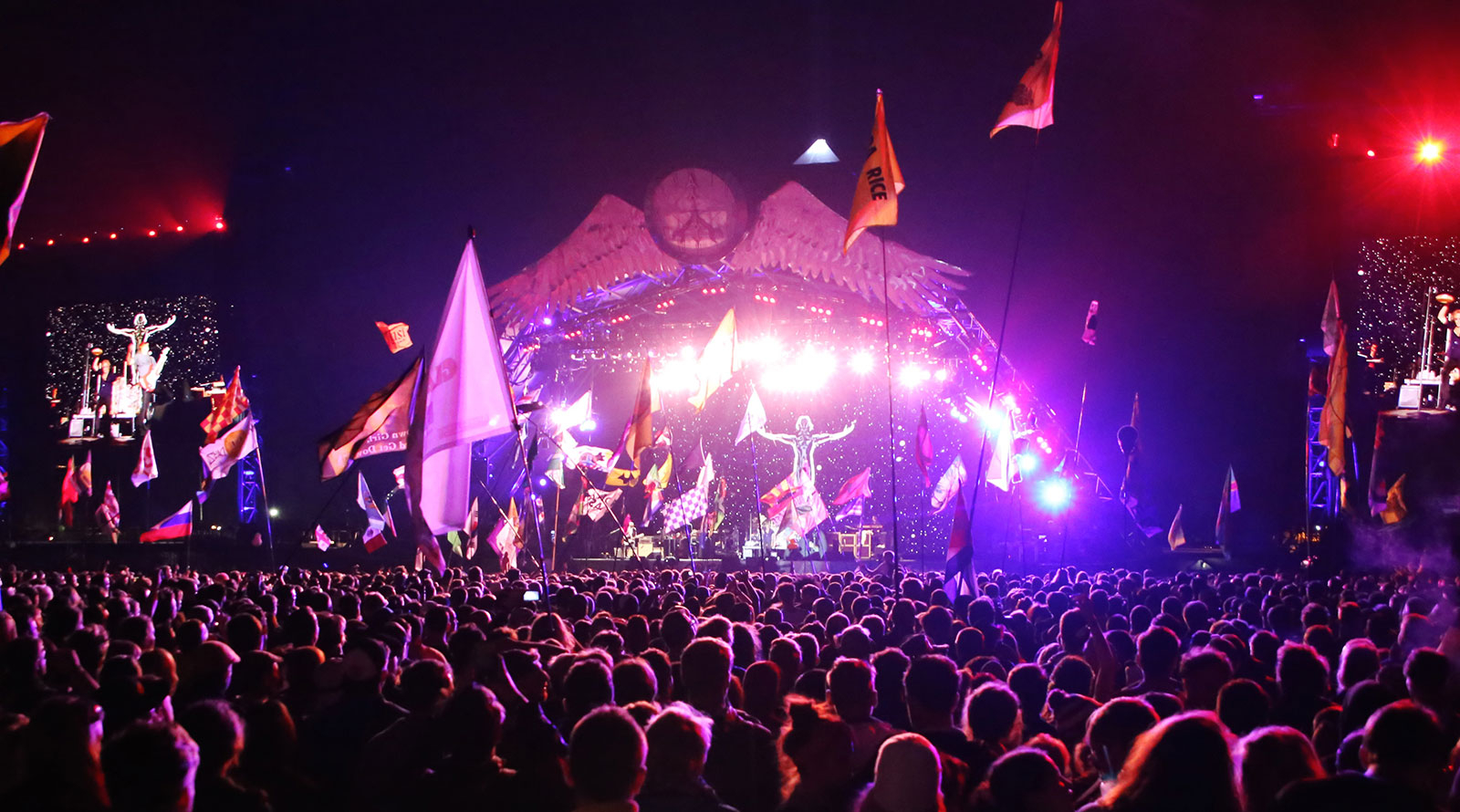
    PILTON, UK – (For Immediate Release) –There’s a reason why Spotify has ranked The Glastonbury Festival of Contemporary Performing Arts (or, Glastonbury, as it is commonly known) as the world’s most influential music festival. Over its 45-year history, the outdoor gathering has played host to a diverse pantheon of stars, from The Rolling Stones to Dolly Parton — not to mention Bruce Springsteen, David Bowie, U2, Metallica and more. This year was no exception with the likes of Florence + The Machine, Pharrell Williams and The Who bringing it to the Pyramid Main Stage. Naturally all eyes were on these stars as they performed, but attention was also focused on an inspiring structure that towered over the iconic stage and glittered in the light from a collection of CHAUVET Professional and ILUMINARC LED fixtures.


    Created by Joe Rush’s Mutoid Waste Company, the structure Peace Time Flies was a giant metallic winged clock that spanned the entire breadth of the Pyramid stage and captured the free, uninhibited and hopeful spirit that defines Glastonbury. This connection between stage sculpture and festival is not surprising. Rush, who achieved notoriety for groundbreaking works like “Carhenge” (a Stonehenge made from old vehicles), began showcasing his work at the Glastonbury 30 years ago. In 2015, the London artist demonstrated that his creative fires still burn with a fierce convention-defying intensity by creating a multitude of senses shuttering works of art, including Peace Time Flies, which symbolizes the hope that the time of peace at Glastonbury could be spread throughout the world.

    photo courtesy of Jason Bryant and Martin Audio

    photo courtesy of Jason Bryant and Martin Audio

    A sweeping sculpture supporting a soaring and noble ambition required bold lighting. This is exactly what was provided by the Iluminarc Colorist Panel 36Qa, which is packed with 36 15-watt RGBA LEDs that radiate bright and vibrant color washes, and the CHAUVET Professional COLORado 1-Quad IP par-style RGBW fixture. A total of nine of the Colorist panels and six of the LED parts were used to direct colored light at the Peace Time Flies. The rich colors of this collection of fixtures animated the sculpture, amplifying the artist’s suggestion of flight, while the intensity of their output ensured that the sculpture would be visible throughout the sprawling grounds.


    Another Rush sculpture stirred equally strong emotions at Glastonbury. Sitting on the top of the Other Stage, the second largest stage at the festival, his Pagan Crown depicted a multi-pointed pagan headdress intertwined with a ram, gazelle and stag horns surrounding a giant pearl. ILUMINARC fixtures were also called upon to accent this structure. This work was illuminated by two Iluminarc Colorist Panel 36Qa panels and eight Iluminarc Colorist Panel 8Qa 15-watt RGBW LED panels. In addition to giving the Pagan Crown an added sense of depth, the fixtures lend a mysterious air to the work with their darker blue and green colored washes.

    2015 Glastonbury - MLA (1)

    Although Glastonbury will always be known and revered for its musical pedigree, it’s the seemingly endless supply of installations, art projects and theatre that really give the festival such broad scope and appeal to people of all ages and tastes. As one of the key non-musical staples to consistently grace Glastonbury, the work of Joe Rush’s Mutoid Waste Company is an essential guardian of this reputation. This year, CHAUVET Professional and ILUMINARC LED fixtures helped this breakthrough artist fulfill his mission in even more brilliant fashion.

    CHAUVET Professional Awes and Engages At The Manor Complex

    _SEX7615

    FORT LAUDERDALE, FL –  The Manor Complex is located about 32 miles north of South Beach, but the crowds that jam pack this spacious 20,000 square foot venue don’t feel a compelling need to journey south on I-95. Why should they? There isn’t much that can’t be found at this very well-appointed superlative nightclub that features a jolt of eye-popping new energy, courtesy of Rogue and ÉPIX Series fixtures from CHAUVET Professional.


    Owners Paul Hugo and Brett Tannenbaum added the Chauvet fixtures to the already powerful light show in the bi-level nightclub, because they believe it’s important to keep their establishment ahead of the entertainment curve.


    “Being in Fort Lauderdale, we draw visitors from all over the world, so we hold ourselves to the highest international standards” said Paul Hugo. “There are a lot of good clubs that are always pushing ahead with new technology, so we felt it was important to keep ours in the forefront. We had a great lighting system, but we wanted to take things a step further so we could add an extra level of energy to the dance floor while offering some incredible looks at the same time.”


    A collection of 12 Rogue RH1 Hybrids, six Rogue R1 Spots and 26 ÉPIX Bar 2.0 one-meter pixel mapping strips, along with 10 Intimidator Series movers from CHAUVET DJ, were added to the Nightclub rig. This powerful aggregation of fixtures has been made all the more impactful by being mounted on two motorized circular truss structures.

    _SEX7554

    “We have two rings of truss,” said Brett Tannenbaum. “The inner ring is 6.5 feet in diameter, and the outer is 16 feet. During the evening, as the action on the dance floor heats up, the truss circles descend down from our 30-foot ceiling. Each truss structure is powered by three motors so they move very well in all directions.”


    The nightclub has one person that just controls the movement of the truss structures and the pixel mapped ÉPIX bars and lasers, while another controls the video and rest of the light show. “The powerful combination of the intense Chauvet lights and the massive moving truss structures really captivates the crowd,” said Tannenbaum.


    “It’s an awe-inspiring spectacle; the prodigious lights on the moving trusses create the sense of a space ship landing on the dance floor,” added Manor’s interior designer and General Manager Gary Santis. “The bursts of color and the different gobo patterns and prisms from the Rogues create something that’s a light show and a Cirque show all in one awesome package.”


    Along with valuing the intensity of the Chauvet fixtures, Hugo and Tannenbaum appreciate their versatility. In keeping with the all-encompassing spirit of the Manor complex, the venue serves as more than just an incredibly popular dance club. The facility also hosts shows by internationally acclaimed acts, as well as an array of contests, revues, receptions and private parties. The Rogue, ÉPIX and Intimidator fixtures help this thriving club wear its many hats in style.

    _SEX7443
    Commenting on the versatility of the Rogue fixtures, Santis stated: “We chose to go with Chauvet’s Rogue fixtures, due to the fact they push the performance boundaries for automated fixtures to new heights. They combine the power of a beam, optics of a spot, and the coverage of a wash. We are an event space that transforms into a nightclub, so these fixtures serve multiple purposes. The versatility of the Rogues helps us create multiple atmospheres and emotions.”


    The elegant looks created by the ÉPIX strips also make a valuable contribution to the club’s presentation. Using the pixel mapped bars to create different looks helps the club maintain its unique and widely praised aesthetic balance that has it harmonizing vintage English touches (hence the name Manor) and crystal chandeliers with modern, cosmopolitan accents.

    _SEX7558

    “We pride ourselves in creating a very memorable welcoming atmosphere that makes it easy to relax yet still excites,” said Tannenbaum. “Without question, we’ve been extremely satisfied with the Rogue, ÉPIX and Intimidator lights. These Chauvet products were an awesome choice because of their reliability, multi-functional capabilities and output, and of course price. Anytime you can go all out to create a nice environment for your customers, yet still stay within your budget, you have to say things are good!”

    Monday Morning Zen – Part 2 of Zen in the Art of Lighting

    Here is part 2 of Zen in the Art of Lighting.  Enjoy!


    Written by Mike Graham, product manager for CHAUVET® Professional

    Question: How many grains of sand are in the desert?
    Answer: Not one more than there has to be.

    When you are working on your design of your light plot, it is important to not throw every single light you have at the stage…unless it absolutely calls for it. Once the set design is finished, your job is to make it look amazing. The key here is not to go over the top. Too often designers make the error of throwing the kitchen sink at a rig just to have more. This is not the way of Zen. Zen dictates that the design does not have to be stark, but the choices have to make sense.

    Plot with Care, Grasshopper.
    It is really easy to stray away from the plan during the plotting stage. Firstly, using software like WISYWIG, MSD, or Vector Works makes dropping in lights really easy. So easy in fact, that the temptation to go overboard is strong. For anyone who doubts this, check out the CHAUVET® LDI 2009, 2010, and 2011 rigs. If there is an open square foot of truss, I am dropping a light in. For a trade show, this is important as the point of the rig is to show what the lights do and how they work together. That is the story line for a trade show, however, this is rarely the case in everyday life.

    Consider the Performance.
    When you are working on the plot, consider the act. Are you working with a smoky blues singer, or are you working on a Fortune 500 gala event. If you are working the blues singer, then having a few down lights, a little front light, and some back light are really effective and will look really cool. If you are working the gala event, then a much bigger rig may or may not be called for. It really depends on the event. Even if you are working on a straight play (a play with no music), there must be a balance. Classic front, side, and back lighting will work perfectly. Cover your acting areas evenly is the key. There is no need for any kind of excessive lighting in these situations.

    Get Practical.
    So let’s say I am plotting a show that will have a few practicals. A practical is a light on a set that would be seen in day-to-day life, like a table lamp or a wall sconce. It can either be controlled by an actor (bad idea) or by the lighting operator (good idea). Let’s say I have four wall sconces and two table lamps, I also have to light around them with theatrical light. This means that I have to take into account what kind of light the practical will put out in relation to what the design intent is when I place my theatrical lights.

    For example, in your house, a table lamp gives off enough light to read by, but not enough to light the whole room. A wall sconce will give off enough light to fill in the places that the table lamp does not. I would use my theatrical lights called specials.

    Stay Special.
    Specials are names for fixtures that are used to accent a specific thing. In this case, the special is used to give the impression that the practical is brighter than it is. A special is a functional light source, not an area light source. As I select my specials, I would choose soft, diffused edges and try to get the color temperature to come in around 3400 K so that it is a little cooler than the practicals will be. This will allow the practicals to be seen and function, but will allow the theatrical lights to give off enough output to let the action be seen. Combined with the basics of front, side, back, and down light, this will give the action the correct amount of light and will not overpower the light itself.

    The plot is set…Let’s start programming.

    Tech Talk Throw Back Thursday!!!! AMX to MPX and DMX

    Wow, that is a lot of T words!

    Check out one of our first ever tech talks from back in 2010 talking about DMX and AMX  Hard to believe it, but there are still systems out there using AMX  to run their lighting systems.  We have come so far with the proliferation of Art-Net, ACN, and SACN since this was written, but still, its all relevant.


    Written by Mike Graham, product manager for CHAUVET® Professional

    Mike Graham pensive in front of MVP™ video panels.

    1. What is AMX? More commonly known as Multiplex or Analog Multiplex, AMX 192 was devised to multiplex up to 192 analog dimmer levels down a four-wire cable. There are thousands of installations that still utilize AMX protocol because the dimming systems they were plugged into were built like Mack Trucks and endured.

    2. The transition to DMX. Boxes to convert DMX into AMX were developed in order to avoid problems with the control. As technology began to become less expensive and started to filter into the lighting world, a new protocol was needed to handle larger dimming racks and moving lights. DMX-512 superseded AMX 192, but it came with its own sets of headaches. No standard existed in how DMX protocol was delivered to fixtures. Each manufacturer had its own method. This left smaller companies that made basic dimming and control in the lurch.

    3. What is MPX and why use it? Several manufacturers began to use a system called Multiplex – a touch of both DMX and AMX. Others used their versions as MPX. So here we are with all of these smaller controllers out there with Multiplex outputs sometimes sitting right along a DMX-512 output.

    When trying to answer some overwhelming questions such as, “What port do I plug into?”, or “How do I keep from ruining a fixture because multiplex puts current down the line?” follow this simple rule of thumb: if you are using like control with like dimmers, Multiplex is the way to go. If Multiplex is all your controller puts out and you want to control intelligent lights, you need to get a new controller.

    Quantum Theatricals Creates “Light and Music Ballet” on Queen Mary 2 With CHAUVET Professional Legends

    Queen Mary2 Arrives NYC Celebrates Cunard Line 175thNEW YORK (For Immediate Release) – The iconic Cunard Line was looking for a way to celebrate the 175th anniversary of its first transatlantic crossing, when Kelly Easterling approached the company with an idea that was outside the box — or perhaps more aptly outside the ship! Easterling, the creative director and principal designer at Quantum Theatricals, proposed creating a dynamic lightshow set to music off the side of the 1,132’ Queen Mary 2, the company’s flagship ocean liner. Much to the delight of the massive crowd in New York harbor on July 14, this is precisely what he and his dedicated team wound up doing with help from 50 intensely bright Legend 230SR Beams from CHAUVET Professional.

    Queen Mary2 Arrives NYC Celebrates Cunard Line 175th


    The 230-watt Legends were the only fixtures used on the ocean liner for the magnificent lighting display. (Four other movers were on shore as part of the show.) Positioned on the railings of the port side promenade deck, the fixtures cast rapidly moving and vividly colored beams across New York harbor and into the sky during the 8-minute show, which began at 9:30 in the evening as the ship held position in front of the Statue of Liberty.


    “It was an impressive sight,” said Easterling. “Our goal was to celebrate the rich history of Cunard and point ahead to its exciting future with a show that was as breathtaking and majestic as the famous ships that sailed under the Cunard banner. We produced the show for two perspectives: the passengers aboard the ship and the people gathered in Battery Park in lower Manhattan. We saw it as a ballet of light choreographed to a sweeping musical score. The show received an incredible response!”

    Queen Mary2 Arrives NYC Celebrates Cunard Line 175th

    Kelly and his lighting designer Richard Chamblin counted on the intense output (96,000 lux at 15 meters) of the 50 Legend 230SR fixtures to create an impactful display for their light-and-music ballet in a “theater” that was really one of the world’s largest harbors.


    “One of the biggest challenges in this project was the distance of the ship relative to Battery Park where the crowd gathered,” said Chamblin. “When this project was being developed we knew the ship would be anywhere from a quarter to a half mile off shore. With that kind of distance we wanted to make sure that the lights would be bright enough to stand out. The biggest deciding factor for us in choosing this fixture was its brightness. The Legend 230SR easily out performs its competitors in lumen output.”

    Queen Mary2 Arrives NYC Celebrates Cunard Line 175th

    The LDs also singled out the Legend 230SR Beam’s 8-facet prism for creating vivid, colorful looks on the harbor’s nearly black night water. “We relied heavily on the Legend’s prisms during the show,” said Chamblin. “At the distance we were using the lights, gobos and zooming features aren’t what’s called for — but the prisms in these fixtures created some really nice looks when we used the water as a palette to illuminate.”


    Overcoming the distance between the ship and the onshore audience was only one of the challenges that Quantum Theatricals faced when pulling off this historic project, which Easterling and his team began working on in March. “When we presented the idea of creating this show, the Cunard executives were very intrigued,” said Easterling. “However everyone was wondering if it could be done. There was a tremendous amount of conversation and research undertaken to ensure that we would have the necessary time and money.”

    Queen Mary2 Arrives NYC Celebrates Cunard Line 175th

    Among the biggest challenges faced by the design team was to ensure that the lightshow, which was timed using SMPTE time code on the ship, and the music sound tracks at Battery Park would be triggered at exactly the same moments. “We couldn’t run a cable from the park to the ship – and streaming SMPTE was not reliable enough,” said Easterling. “So we commissioned a custom GPS triggering system that utilized GPS time clocks to trigger the start of the show both on land and on the ship at the exact same moment in time. The clock sent a trigger to the control consoles on the ship and in the park at precisely the same time, so we wound up with the lighting effects on the Queen Mary 2 being perfectly synchronized with the soundtrack at Battery Park.”


    The New York appearance of the Queen Mary 2 marked the final stop in a three-country tour that celebrated Cunard’s 175th anniversary. Retracing the July 1840 journey of the company’s original RMS Britannia, the QM2 began its crossing at South Hampton, then stopped in Liverpool before setting forth to Halifax, Nova Scotia, then on to Boston and New York.

    Queen Mary2 Arrives NYC Celebrates Cunard Line 175th

    Capping off this transatlantic journey with an amazing nighttime spectacle required an incredible degree of coordination before the first Legend 230SR Beams were ever turned on. Among the agencies that cooperated to make the show possible were the US and Canadian Customs, The US Coast Guard, the City of New York, and the Federal Aviation Administration.


    “Given that the lumen output of the Chauvet fixtures was so high, we were required to contact the FAA at JFK moments prior to the performance to get clearance and then contact them again following the show to notify them that we had finished,” said Easterling. “This was done so that the Air Traffic Control Tower could notify any aircraft in the area of the show and warn them of the bright moving lights. Additionally, we worked closely with Cunard’s UK team to develop a marine plan that detailed the exact longitude and latitude of the ship for the show, which was then approved in advance by local and federal agencies.”

    Queen Mary2 Arrives NYC Celebrates Cunard Line 175th

    Like any project of this magnitude, the Cunard 175th Anniversary required a tremendous team effort. “We’re all quite grateful to our Canadian Production Manager Shaw Fortis, who really coordinated the gear and logistics. His insight and guidance kept the show on track and on budget,” said Easterling. “Solotech and Christie handled our Canadian rentals (we loaded the show onto the ship in Halifax), and WorldStage handled the shore-side support in New York. All of these companies were splendid to work with. Finally, Earlybird Visual took care of our pre-visualization of the show and did stellar work.”


    After the anniversary celebration, the Queen Mary 2 sailed out of New York harbor while Easterling, Chamblin and the rest of the Quantum Theatricals team took a step back to appreciate what they had accomplished. “When you’re in the middle of the project you’re too preoccupied with things,” said Easterling, “Now I love looking at the photos and videos of that night.” Apparently a lot of other people do too. Shortly after the celebration ended, an image of the Legends in action on the Queen Mary 2 was the number one photo in the Huffington Post’s “Pictures From Around The World.”
    # # #

    For more information on Quantum Theatrical visit: www.quantumtheatricalservices.com


    To see how Quantum Theatricals set this up, check out the video

    Here are some of the festivities around the Queen Mary 2’s celebration of 175 years of Cunard

    For a little more information on the LEGEND 230SR Beam see the below

    Lighting Insights July 2015 – Expect The Unexpected: Lighting Club Tours With Victor Zeiser

    LIGHTING_INSIGHTS_LOGO

    Recording contracts and stadium concerts are great, but in this era of YouTube and music streaming, a lot of bands are doing just fine without them. Playing everything from jam to jangle and emo to post hardcore, these grass roots groups are building sizable fan bases by purveying their music online and touring like crazy.

    lighting insitghts 2

    Often playing 100 or more gigs a year in venues that rarely exceed 2000 capacity, a new generation of road warrior bands have created a renaissance of live grass roots music, the likes of which haven’t been seen since the coffee house era of the 1960s. In the process, they’ve also created new opportunities for lighting designers. As children of a highly visual age, they almost always place a premium on having a distinctive look on stage with a lightshow that is uniquely their own.

    New York lighting designer Victor Zeiser of Squeek Lights has chalked up plenty of miles working with touring bands, having designed for some of the most successful like Grammy winners They Might Be Giants and Canadian cult favorite Silverstein, to some lesser known groups. Zeiser, who also keeps busy as the LD for the Hammerstein Ballroom in Manhattan, shared his thoughts on designing for the new generation of traveling troubadours…Read the rest!

    Audiosure and CHAUVET Professional Dazzle Visitors at Mediatech Africa 2015

    Mediatech

    JOHANNESBURG, SOUTH AFRICA–  By any measure, the Mediatech Africa 2015 Advanced Technology Trade Show was an outstanding success for Audiosure. The South African company drew large appreciative crowds to see its extensive collection of audio and AV products as well as lighting from CHAUVET Professional and CHAUVET DJ.


    However, beyond being drawn by the opportunity to get their hands on some of the latest gear, show visitors were stopped in their tracks by an eye-popping lightshow Audiosure created using a collection of CHAUVET Professional fixtures.


    Designed by Sean Crawley with the assistance of Stefan Van Der Walt, the show at the Audiosure stand drew on the intense output of 16 pixel-mapped Nexus 4×4 LED panels to display blinding breakout patterns and stunningly bright text. Adding to the visual feast was the sweeping light from 30 ultra-fast Rogue moving fixtures. The new Strike 4 blinder pumped up the intensity level even higher, as did four Next NXT-1 moving LED panels flown on the rig’s truss. A group of eight COLORado 2-Quad Zoom IP fixtures washed the booth in a rich array of colors during the show.

    Mediatech2

    “The lightshow at the Audiosure stand was really quite special,” said

    Stéphane Gressier, International Sales Director of Chauvet. “It really showed how lighting can transform a space, especially when in the hands of talents like Sean and Stefan. We’ve always believed that the best way for anyone to appreciate what our lights can accomplish is to see them in action. This enthusiastic response to the show at the Audiosure stand certainly proved this point.”